The featured image was AI-generated from a photograph,
with the cat modeled after our family cat.
PR / Ad|This post contains affiliate links.
Read the English + Japanese version|英語+日本語版はこちら
Introduction|はじめに
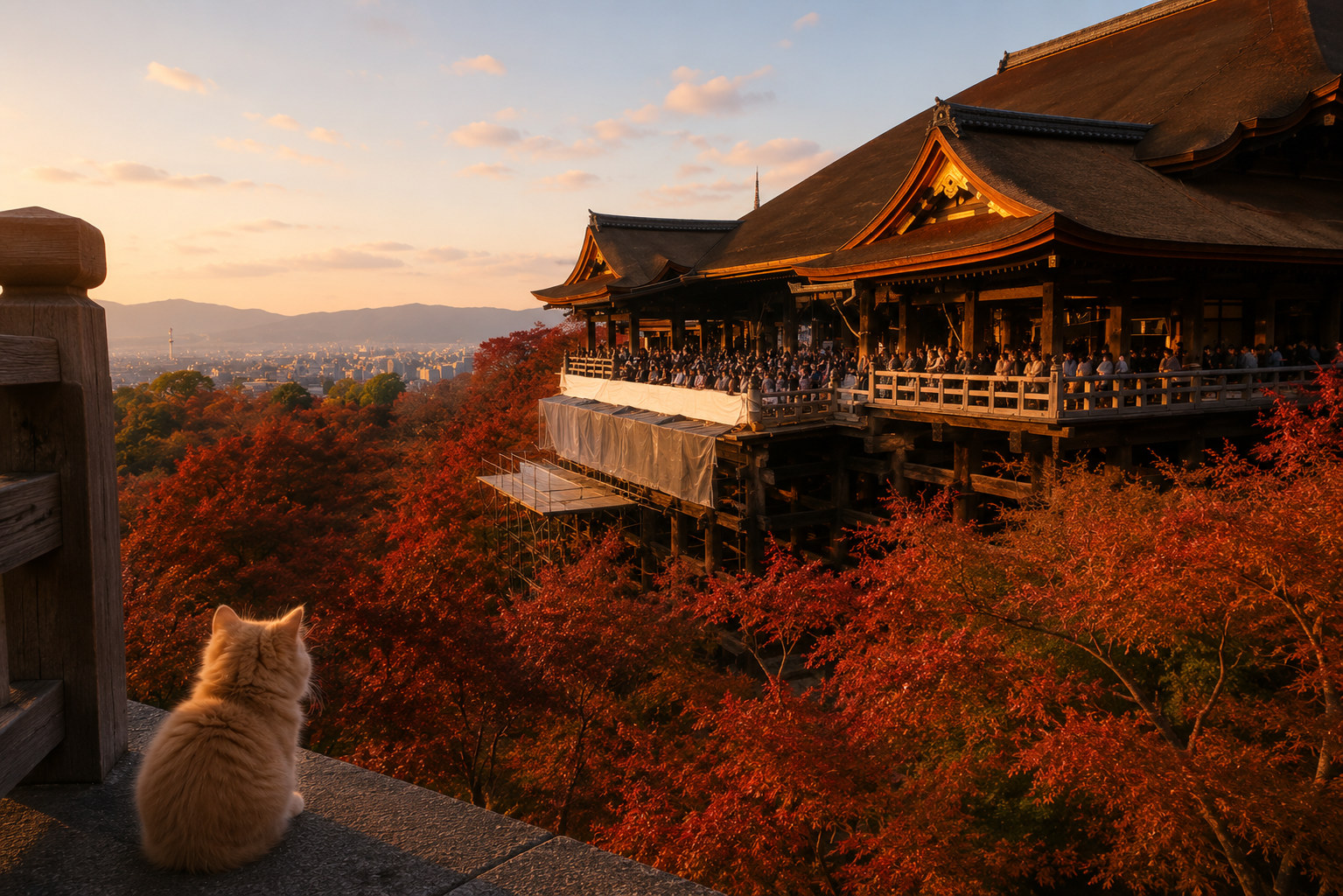
Kiyomizu-dera
is one of Kyoto’s
most famous temples.
Founded in 778,
it has welcomed worshippers
to the slopes of Mount Otowa
for more than 1,200 years.
Its wooden stage,
historic buildings,
and sacred waterfall
make it one of Kyoto’s
most memorable places to visit.
🟫 MINI MEMO
In 1994,
Kiyomizu-dera became part of
the UNESCO World Heritage Site
“Historic Monuments of Ancient Kyoto.”
History & Cultural Heritage|歴史・文化財
The history of Kiyomizu-dera
began in 778.
According to the temple’s history,
a monk named Kenshin,
who was later known as Enchin,
received guidance in a dream
and travelled to Mount Otowa.
There,
he found a waterfall
with clear flowing water
and met an ascetic named Gyōei.
Two years later,
the warrior
Sakanoue no Tamuramaro
visited Mount Otowa.
He and his wife,
Miyoshi no Takako,
helped establish a temple
dedicated to the Eleven-Faced
Thousand-Armed Kannon.
The temple was named
Kiyomizu-dera,
meaning “Pure Water Temple,”
after the clear water
of Otowa Waterfall.
Kiyomizu-dera suffered
many fires
during its long history.
Most of the temple buildings
seen today
were rebuilt in 1633.
The Main Hall
is designated
as a National Treasure.
The Niōmon Gate,
West Gate,
Three-Storied Pagoda,
and many other buildings
are protected as
Important Cultural Properties.
Niōmon Gate|仁王門
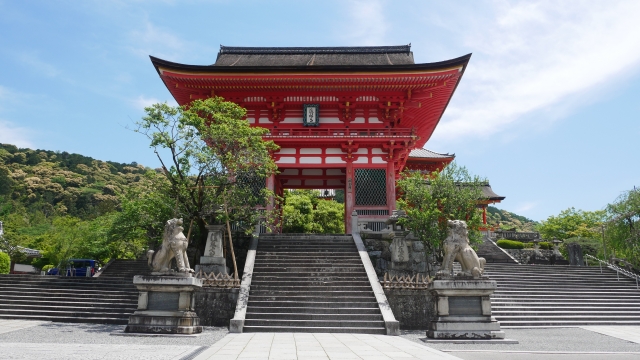
The Niōmon Gate
is the main entrance
to Kiyomizu-dera.
The earlier gate
was destroyed by fire
during the Ōnin War in 1469.
The present gate
was rebuilt
around the year 1500.
Its vivid vermilion color,
large wooden structure,
and gently curved roof
create an impressive entrance
to the temple grounds.
Two guardian statues
stand inside the gate,
protecting the sacred area.
🟫 PHOTO TIP
Try taking a photograph
from the lower part
of the approach.
The stone steps,
vermilion gate,
and blue sky
fit beautifully
into one frame.
West Gate|西門
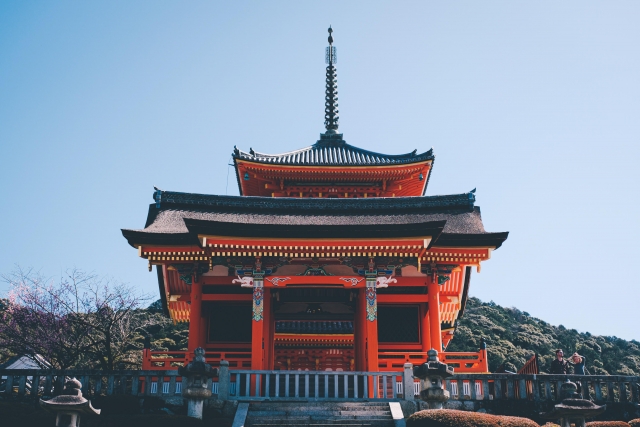
The West Gate
stands near
the Niōmon Gate.
The present structure
was rebuilt in 1633
and is designated
as an Important Cultural Property.
The gate has long been associated
with the setting sun
and the Western Pure Land
in Buddhist belief.
Looking toward the setting sun
while contemplating
the Western Pure Land
is part of a Buddhist practice
known as Nissōkan.
People once watched
the sun disappear
beyond the distant mountains
while directing their thoughts
toward the Western Pure Land.
🟫 MINI MEMO
The West Gate
is not simply
a place to enjoy the sunset.
It is a sacred place
connected with
a long history
of Buddhist prayer.
Three-Storied Pagoda|三重塔
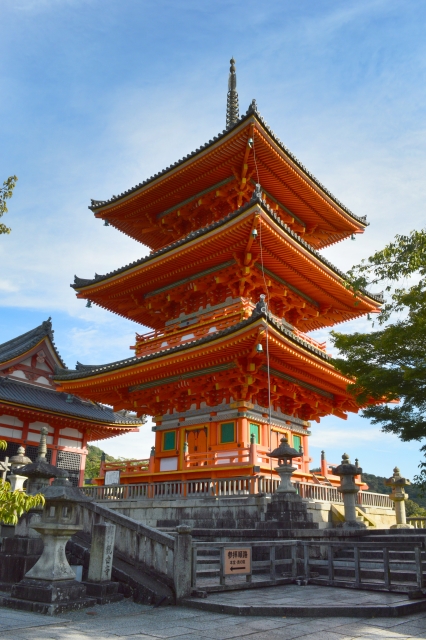
The Three-Storied Pagoda
is one of the most recognizable
buildings at Kiyomizu-dera.
Standing approximately
30 meters high,
it is one of the largest
three-storied pagodas in Japan.
The pagoda
was first built in 847.
The present structure
was rebuilt in 1632
and is designated
as an Important Cultural Property.
Its vivid vermilion color
can be seen
from many parts of Kyoto.
Dainichi Nyorai
is enshrined
inside the pagoda.
The interior is decorated
with colorful Buddhist paintings
and images of dragons.
🟫 PHOTO TIP
Morning and late-afternoon light
can bring out
the warm vermilion color
of the pagoda.
Try including
the surrounding trees
to show how the pagoda rises
above the temple grounds.
Zuigudō Hall|随求堂
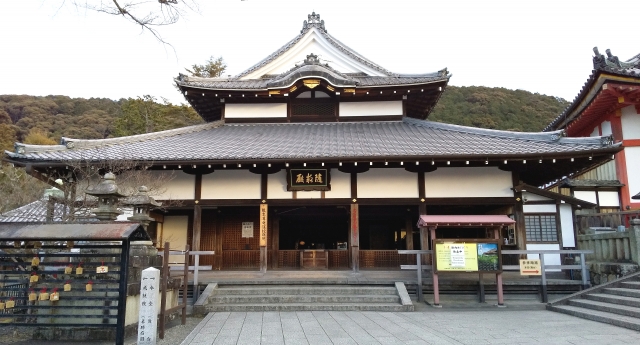
Zuigudō Hall
was built in 1735.
Its principal image
is Daizuigu Bosatsu,
a Buddhist figure believed
to respond to the wishes
and prayers of all people.
The hall is also known
for “Tainai Meguri,”
a symbolic journey
through complete darkness.
Visitors walk slowly
through the darkness
while holding a rope
made to resemble
large prayer beads.
The journey
symbolically represents
passing through
the womb of a bodhisattva.
Rather than enjoying
an outside view,
Tainai Meguri offers
a quiet moment
to focus on your senses
and thoughts.
🟫 REAL INFO
Reception hours,
fees,
and entry conditions
for Tainai Meguri
may change.
Please check
the official Kiyomizu-dera website
or the information at the hall
before entering.
Main Hall|国宝・本堂
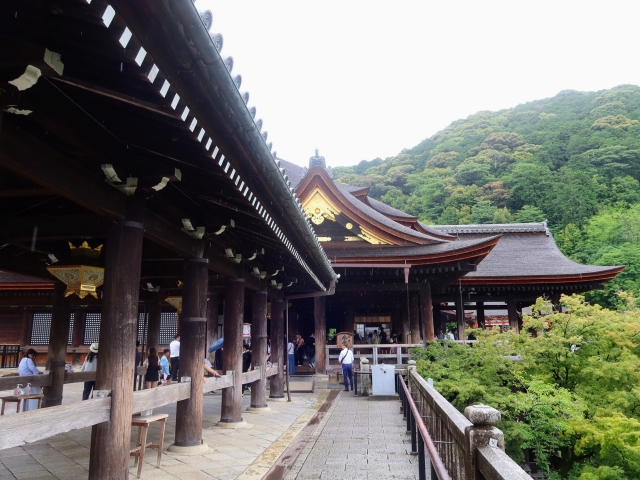
The Main Hall
is the center
of prayer and worship
at Kiyomizu-dera.
The present wooden building
was rebuilt in 1633
and is designated
as a National Treasure.
The sacred principal image
is the Eleven-Faced
Thousand-Armed Kannon,
a bodhisattva representing
great compassion.
The image is normally hidden
in the innermost sacred area
of the Main Hall.
Although Kiyomizu-dera
is famous
for its views and architecture,
the Main Hall is first and foremost
a place of prayer.
Take a quiet moment
to place your hands together
before stepping
onto the stage.
🟫 REAL INFO
Please speak quietly
and follow the signs
around the prayer areas.
The inner sacred areas
are normally closed
to visitors,
except during certain
special religious events.
Kiyomizu Stage|清水の舞台
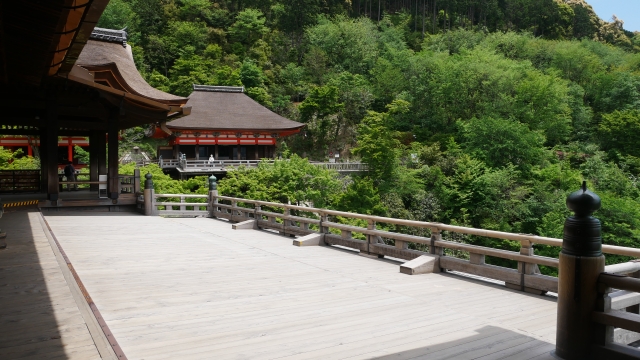
The famous
Kiyomizu Stage
extends outward
from the Main Hall
over the steep hillside.
The stage stands
approximately 13 meters
above the stone foundations below.
From here,
visitors can enjoy
wide views across Kyoto.
The stage is supported
by 18 large
zelkova pillars.
Thick wooden beams
pass through the pillars
to form a strong
interlocking framework.
This traditional construction method
is called kake-zukuri.
The wooden structure
is assembled
without using nails
in its joints.
The stage was originally created
as a place to dedicate
music,
dance,
and other performing arts
to Kannon.
Its beautiful view
is famous today,
but the stage has always been
closely connected
with prayer and religious ceremonies.
🟫 MINI MEMO
The Japanese expression
“to jump from
the stage of Kiyomizu”
means to make
a bold decision
with great determination.
Otowa Waterfall|音羽の瀧
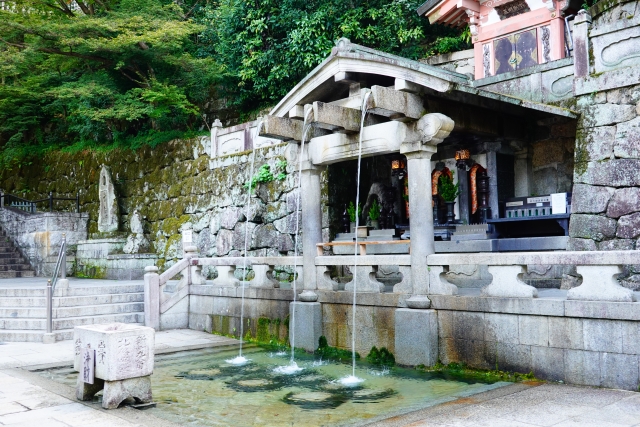
Otowa Waterfall
flows beneath
the Main Hall.
Its clear water
gave Kiyomizu-dera
its name,
which means
“Pure Water Temple.”
The water falls
in three streams.
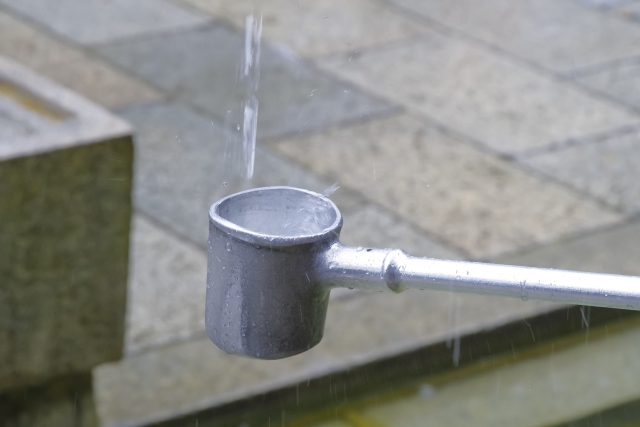
Visitors use
long-handled cups
to receive the water
and pray for purification
and the fulfilment
of their wishes.
The water has long been known
as “Golden Water”
and “Life-Prolonging Water.”
Otowa Waterfall
has been respected
as a sacred place
of purification and prayer
for many centuries.
🟫 MINI MEMO
The three streams
are often associated with
academic success,
good health,
and good relationships
and connections.
However,
many different meanings
and traditions
have developed
over the temple’s long history.
🟫 REAL INFO
Otowa Waterfall
is a sacred place
and can become crowded.
Please wait patiently,
follow the signs,
and allow other visitors
to approach the water.
Seasonal Scenery & Special Night Viewing|季節の風景・夜間特別拝観
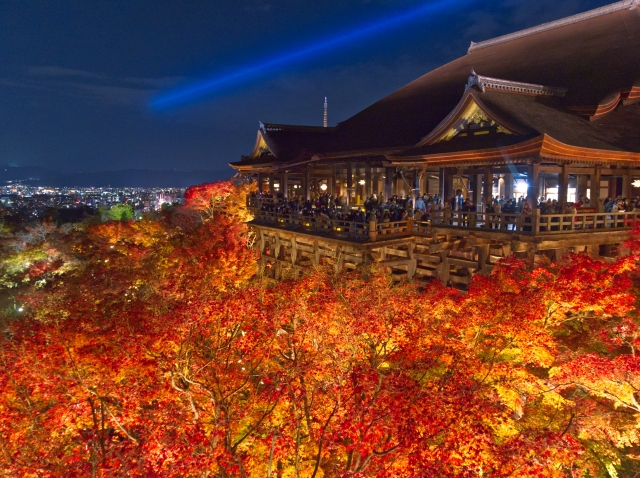
Kiyomizu-dera offers
different scenery
throughout the year.
Cherry blossoms
surround the temple
in spring.
In early summer,
fresh green leaves
cover the slopes
of Mount Otowa.
Autumn brings
vivid red,
orange,
and golden leaves.
In winter,
the shapes
of the wooden buildings
and surrounding hills
can be seen more clearly.
Special night viewing
is held during
selected periods
of the year.
The illuminated temple buildings
and a beam of blue light
create a very different atmosphere
from the daytime.
The blue beam
symbolizes
the compassion of Kannon.
Dates,
opening hours,
and admission information
may change.
Please check
the official Kiyomizu-dera website
before visiting.
🟫 PHOTO TIP
The time between sunset
and complete darkness
often creates
a beautiful contrast
between the deep blue sky
and the illuminated
temple buildings.
🟫 CAT MEMO 🐾
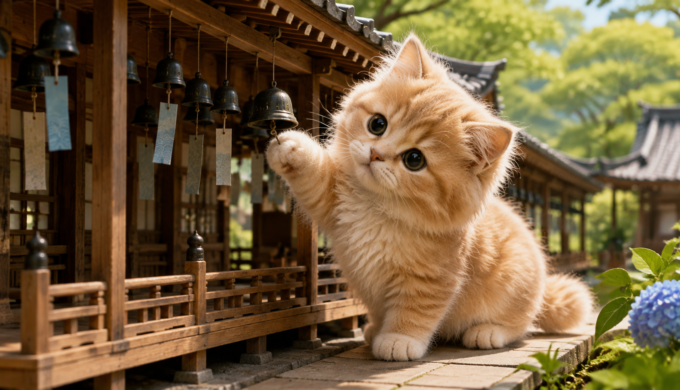
Chirin, chirin♪
“Just one little tap…
It made such a pretty sound, nya♪”
🗺 Google Map
Kiyomizu-dera is more than
its famous wooden stage.
Its historic buildings,
sacred water,
and quiet atmosphere of prayer
may stay with you
long after your visit. 🌿
Thank you for visiting
Kiyomizu-dera. 🐾
🗺 Explore More Kyoto Areas
Kyoto is divided into several unique areas, each offering different attractions and experiences.