The featured image is AI-generated and inspired by Eikando Temple,
with the cat modeled after our family cat.
PR / Ad|This post contains affiliate links.
Read the English + Japanese version|英語+日本語版はこちら
Introduction|はじめに
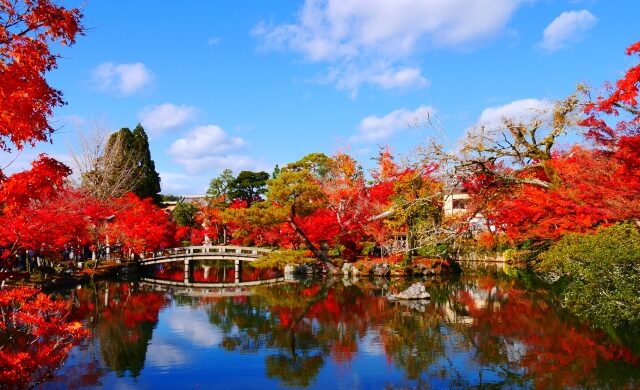
Red and golden maples.
A peaceful pond.
Temple halls along the hillside.
Eikando Temple is known
for its beautiful autumn leaves.
But among these familiar views,
there is something unusual.
A wooden corridor
winds along the hillside.
It is called Garyuro,
the Sleeping Dragon Corridor.
Why was it given
the name of a dragon?

A Temple on the Hillside|山の斜面に建つお寺
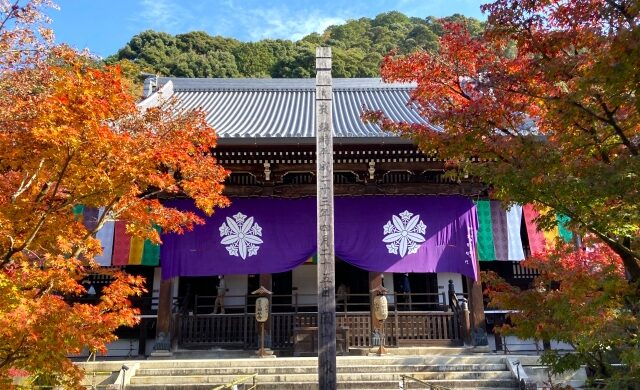
Eikando stands
at the foot of Kyoto’s
Higashiyama mountains.
Its temple halls stand
at different heights
along the hillside.
Wooden corridors
connect these buildings,
following the shape
of the terrain.
The Winding Stairs|曲がりながら続く階段
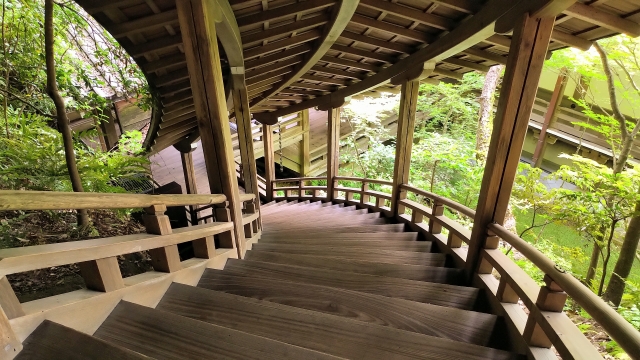
Look at the wooden stairs.
They do not follow
a single straight line.
Instead, they bend and turn
along the steep slope.
A roof stretches overhead.
Wooden railings follow
the winding path.
The corridor seems
to flow through the trees.
Why a Dragon?|なぜ龍なの?
The name Garyuro
offers a clue.
Garyu means
a dragon lying down.
The winding staircase
resembles a dragon
lying on the rocks.
Its unusual shape
also reflects
the steep mountain terrain.
Temple records mention
the construction of Garyuro
in 1504.
Its history stretches back
more than 500 years.
Another Way to See the Corridor|見方を変えてみる
From one end,
the stairs stretch away
beneath the wooden roof.
From another angle,
their winding shape
becomes easier to notice.
Knowing its name,
we may begin to imagine
a dragon resting
along the hillside.
Notice how the roof
and stairs bend together.
If you can view the corridor
from another permitted angle,
compare its shape.

looks most like a dragon to you?
Mikaeri Amida|振り返る阿弥陀さま
Eikando is also home
to Mikaeri Amida,
the Looking-Back Amida Buddha.
Unlike most Amida statues,
its face turns
over its left shoulder.
According to temple tradition,
the story dates back to 1082.
While the monk Yokan
was practicing nenbutsu,
the statue began walking
ahead of him.
Yokan stopped in surprise.
Amida turned back and said,
“Yokan, you are slow.”
The looking-back posture
is often seen
as a symbol of compassion.
It suggests a Buddha
who does not forget
those who fall behind.
The statue is designated
an Important Cultural Property
of Japan.
It is enshrined
in the Amida Hall.
Hojo Pond|放生池に映る景色
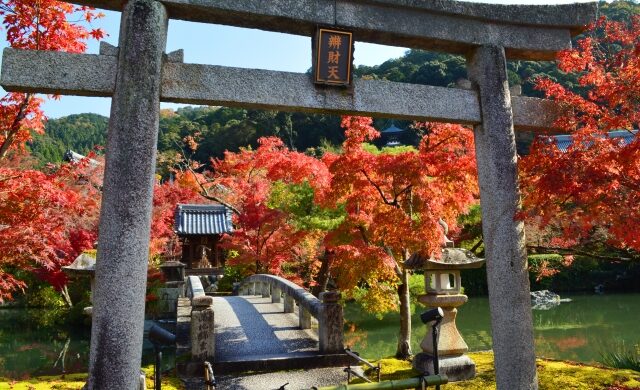
Near the center
of the temple grounds
lies Hojo Pond.
A small island,
a bridge,
and a stone torii gate
create a peaceful view.
The bridge is called
Kinun Bridge.
On calm days,
the trees and bridge
may be reflected in the water.
Tahoto Pagoda|多宝塔と京都の眺め
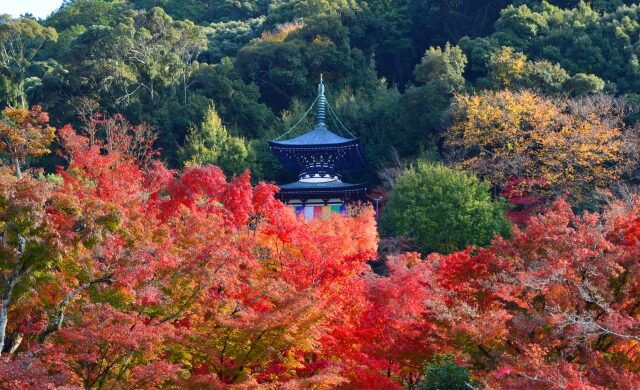
Higher on the hillside
stands the Tahoto Pagoda.
Rising above the trees,
it is one of Eikando’s
distinctive landmarks.
Stone steps lead uphill.
From the higher grounds,
visitors can enjoy
views across Kyoto.
Autumn and Fresh Green Leaves|紅葉と青もみじ
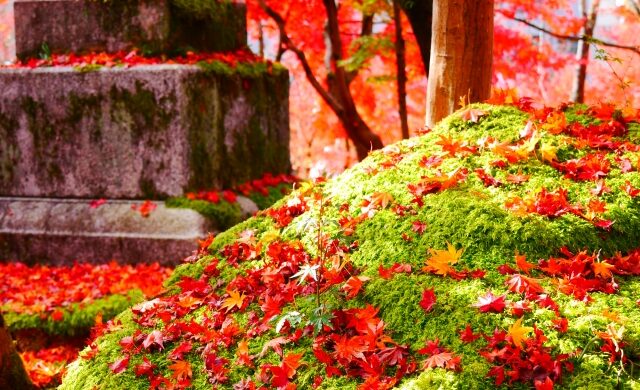
Eikando has long been known
as a temple of maple leaves.
In autumn,
red and golden colors
spread across the grounds.
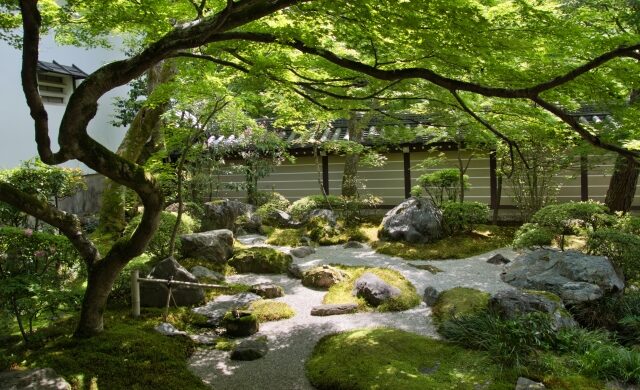
Yet autumn is not
the only beautiful season.
Fresh green maples
bring a peaceful atmosphere
in spring and summer.
Garyuro Corridor is scheduled
to be closed to visitors
from November 11 to December 6, 2026.
Please check the official website
for the latest information.
🗺 Google Map
Please check the official website
for the latest information before your visit.
🟫 CAT MEMO 🐾

“So many colorful leaves…
Which one should I tap first?”
Beyond its beautiful autumn leaves,
Eikando has stories to discover.
A corridor shaped like a dragon,
and an Amida Buddha
who looks back with compassion.
Thank you
for visiting
Eikando Temple.
We hope your time
in Higashiyama
brings you peace,
beautiful memories,
and a wonderful journey
through Kyoto. 🐾
🗺 Explore More Kyoto Areas
Kyoto is divided into several unique areas, each offering different attractions and experiences.