The featured image is an AI-generated illustration.
PR / Ad|This post contains affiliate links.
Read the English + Japanese version|英語+日本語版はこちら
Introduction|はじめに
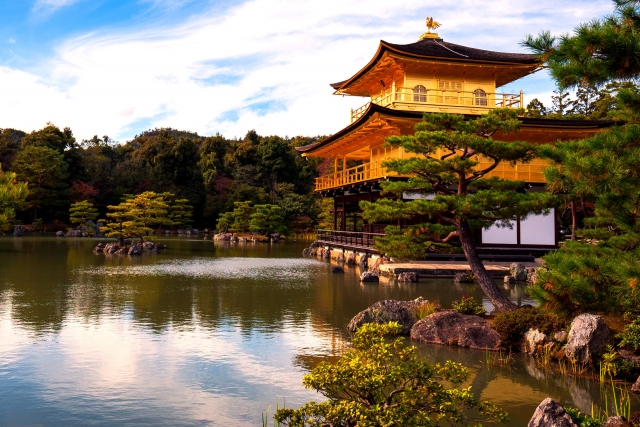
A golden pavilion beside a quiet pond.
The changing reflections of trees and sky.
One of Kyoto’s most memorable views.
Kinkaku-ji is the popular name
of Rokuon-ji, a Zen temple
associated with Ashikaga Yoshimitsu.
But why does the pavilion shine in gold?
And what stories are hidden
in the garden around it?

Why Is Kinkaku Golden?|なぜ金閣は金色なの?
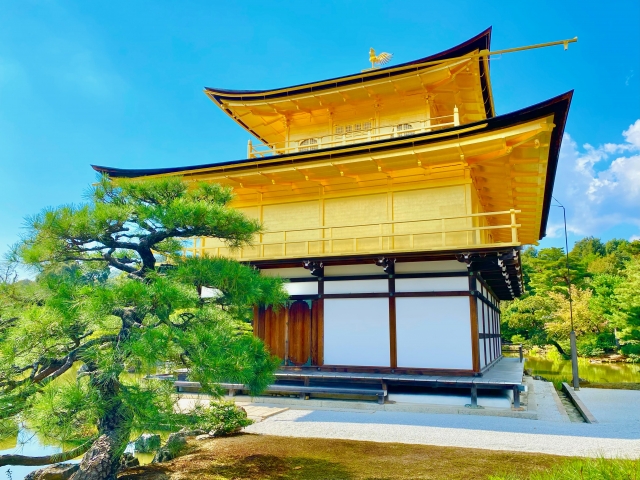
In 1397, Ashikaga Yoshimitsu,
the third shogun of the Muromachi shogunate,
began building his villa, Kitayama-dono,
on this site.
The villa became a center
of the refined culture
now known as Kitayama Culture.
After Yoshimitsu’s death,
it was converted into a Zen temple
called Rokuon-ji.
The pavilion’s second and third floors
are covered with gold leaf over lacquer.
The temple explains that the pavilion
and its garden were designed to evoke
the Buddhist Pure Land.
The gold-covered upper floors also reflect
the splendor of Kitayama Culture.
■ Memo|Three Floors, Three Architectural Styles
Each floor has a different design:
an aristocratic residential style below,
a samurai residential style in the middle,
and a Zen Buddhist style above.
The original pavilion burned down in 1950.
The building seen today was rebuilt in 1955.
Golden Phoenix|屋根の上の鳳凰
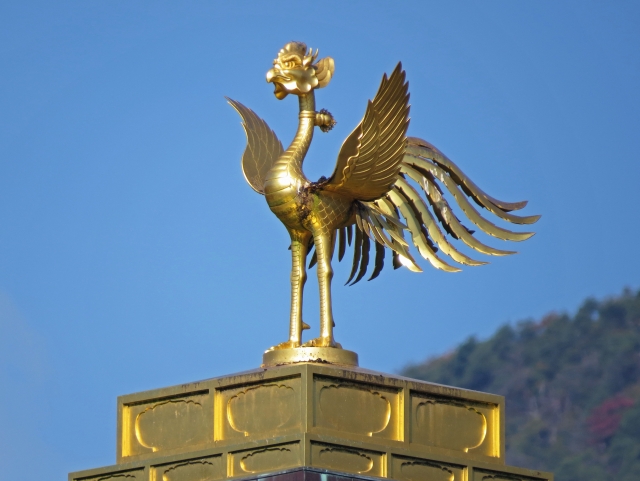
Look closely at the top of the roof.
A golden phoenix stands above the pavilion.
The phoenix is an auspicious bird
in East Asian tradition.
Seen from across the pond,
it may appear surprisingly small.
■ Memo|The Phoenix That Survived the Fire
According to historical accounts,
the phoenix from the former pavilion
had been removed before the 1950 fire
and escaped the destruction.
what other stories are waiting
in the garden?
Kyōko-chi Pond|水面に映るもう一つの金閣
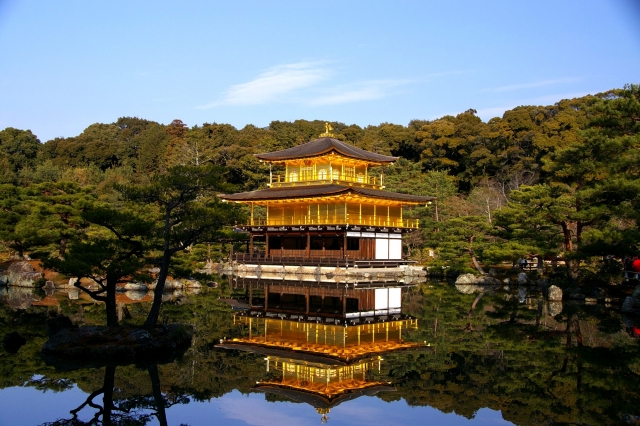
Kyōko-chi Pond spreads out
in front of the Golden Pavilion.
Its islands, stones and trees
are part of a carefully composed garden.
On a calm day,
the pavilion may appear again
on the surface of the water.
The view changes with the wind and light.
■ Photo Tip|The Golden Pavilion Reflected in the Pond
Try including both the pavilion
and its reflection in one frame.
A calm pond can create
a beautiful mirror-like view.
Rikushū-no-Matsu|船の形をした松
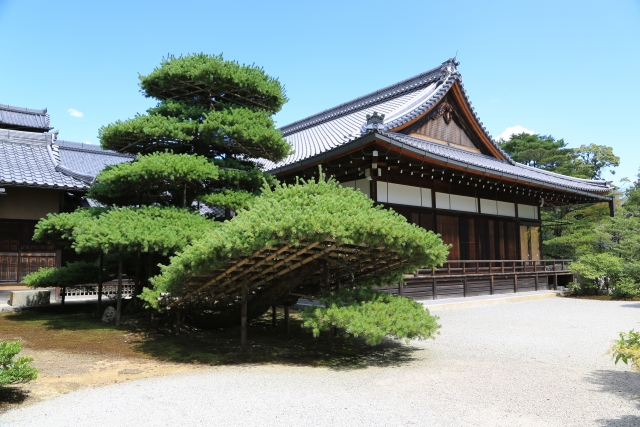
Rikushū-no-Matsu is a pine tree
shaped like a sailing boat.
It is traditionally said
to have been planted by Yoshimitsu.
Its boat-like shape invites visitors
to imagine a journey across the garden.
In Buddhist tradition, the Pure Land
is associated with the west.
Step back a little to appreciate
the long branches and the shape
of the entire boat.
Ryūmon Waterfall|龍になる鯉の伝説
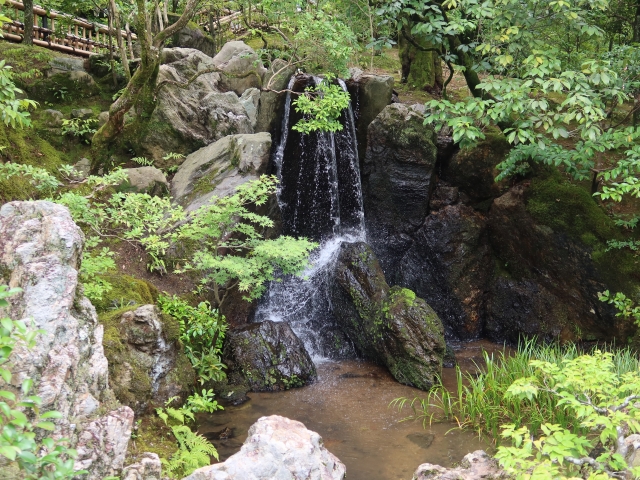
Ryūmon Waterfall is a small waterfall
about 2.3 meters high.
At its base is a stone
called Rigyo-seki, or the Carp Stone.
The stone evokes a carp
struggling to climb a waterfall.
It recalls the Chinese legend
of a carp that becomes a dragon.
■ Memo|The Origin of the Word “Tōryūmon”
The Japanese expression tōryūmon
refers to a difficult gateway
leading to success.
It comes from the legend
of the carp climbing the waterfall.

🟫 CAT MEMO 🐾
“S-so bright, nya…!” 🐾
🗺 Google Map
Please check the official website for the latest information before visiting.
Kinkaku-ji is more than
a beautiful golden pavilion.
Its architecture tells a story
of Yoshimitsu and Kitayama Culture.
The pond, the boat-shaped pine
and the little waterfall
each hold stories of their own.
Beyond these,
visitors can also discover
Anmintaku Pond, Sekka-tei Tea House
and Fudō-dō Hall.
Perhaps knowing these stories
will make your walk through the garden
a little more memorable.

Thank you
for visiting
Kinkaku-ji.
May your time here
bring you peace
and beautiful memories.
And may your journey
through Kyoto
be a wonderful one. 🐾
🗺 Explore More Kyoto Areas
Kyoto is divided into several unique areas,
each offering different attractions and experiences.