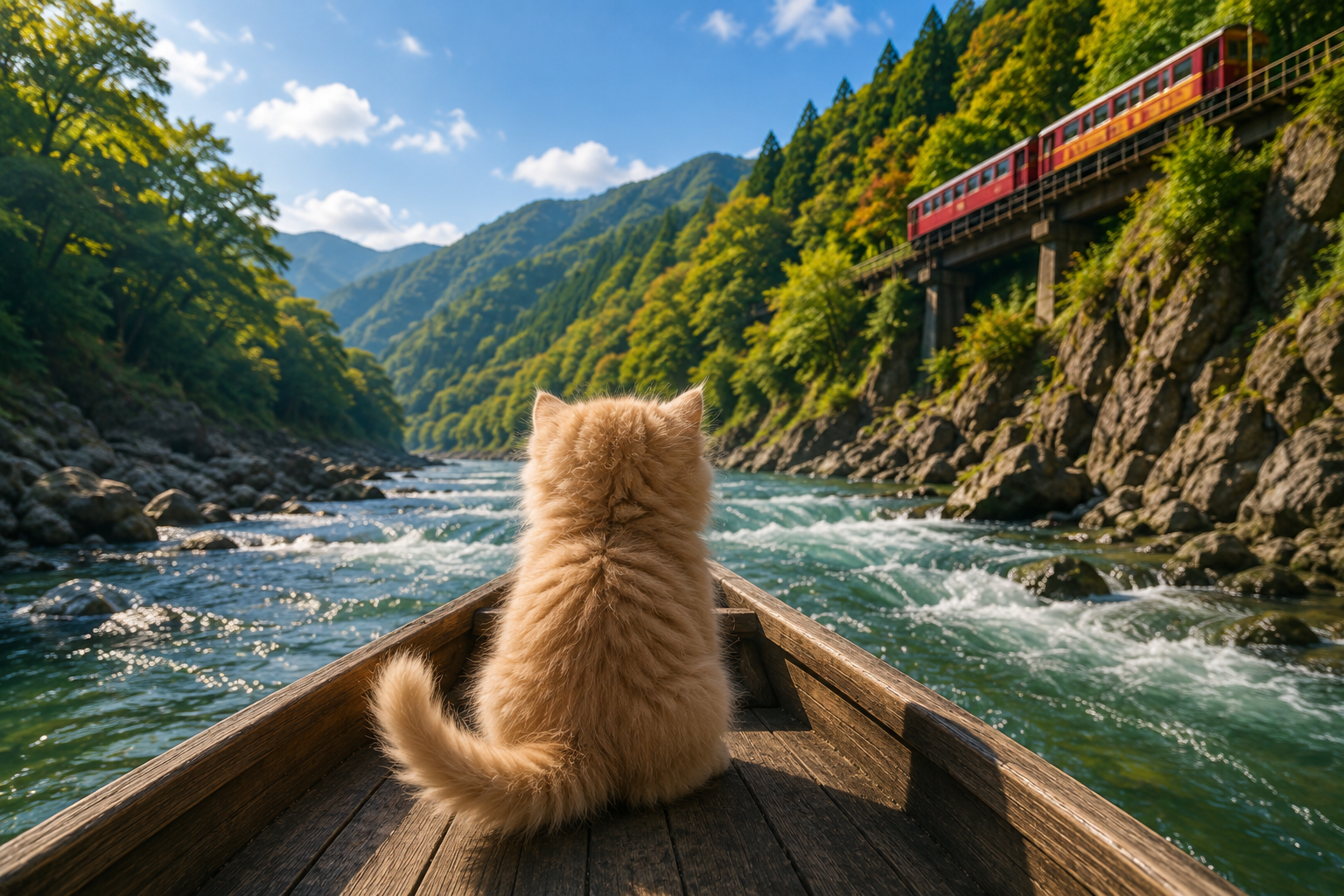
The featured image is an AI-generated illustration.
PR / Ad|This post contains affiliate links.
Read the English + Japanese version|英語+日本語版はこちら
Introduction|はじめに
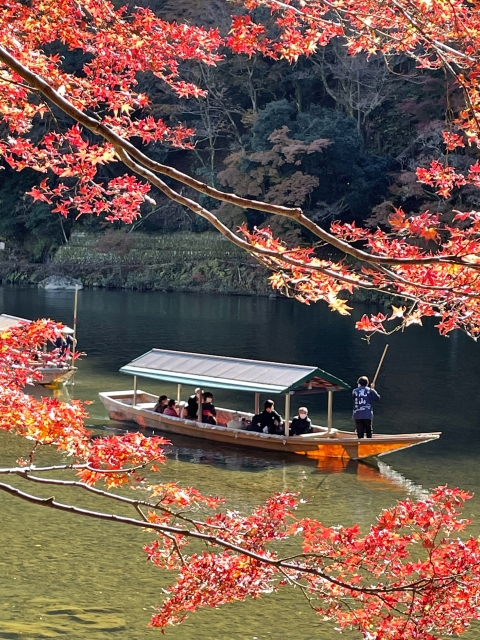
A wooden boat on the river.
Rocky cliffs rising on both sides.
The sound of water
flowing through the gorge.
The Hozugawa River Boat Ride
takes visitors from Kameoka
to Arashiyama, Kyoto,
along approximately 16 km
of beautiful river scenery.
But this river was not always
a place for sightseeing.
More than 400 years ago,
boats carried goods
through these mountains.
Today, skilled boatmen
still guide wooden boats
using poles, oars,
and a large rudder.
Why are these traditional skills
still part of the journey?

A River with History|400年を超える舟運の歴史
The history of river transport
on the Hozugawa
goes back more than 400 years.
In 1606,
the merchant Suminokura Ryoi
developed the river
as a transportation route.
Timber, rice, firewood,
and other products
from the Tamba region
were transported toward Kyoto.
The river connected
mountain communities
with the city.
■ Memo|From Transport to Tourism
As railways developed,
river transport gradually declined.
The river later became famous
for sightseeing boat rides.
The purpose of the boats changed.
But the knowledge needed
to navigate the river
continued to be passed down.
Three Boatmen, One Boat|3人で操る一艘の舟
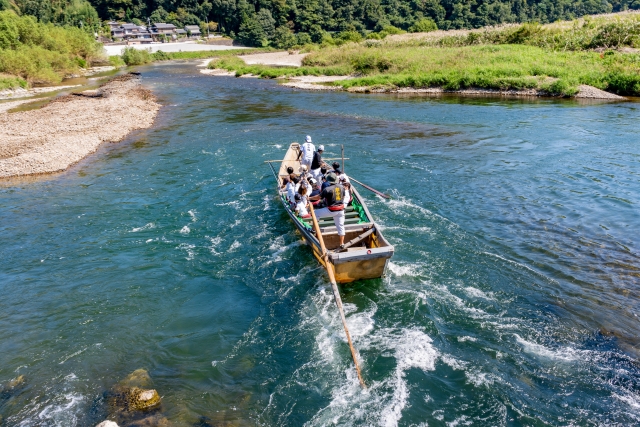
A traditional Hozugawa boat
is guided by three boatmen.
Each has an important role.
At the front,
one boatman uses a long bamboo pole
to push against rocks
and guide the boat.
Another boatman
uses an oar to propel
and control the boat.
At the back,
the third boatman
controls a large rudder
to steer the boat.
■ Memo|Three Traditional Skills
Pole — guiding the boat around obstacles.
Oar — providing power and control.
Rudder — steering the boat.
The boatmen must work together,
responding to the current
and the rocks ahead.

Through the Rapids|岩と急流を越えて
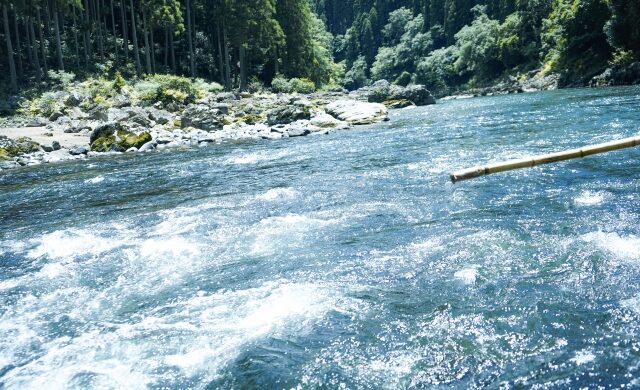
The Hozugawa River
is not always calm.
Some sections are gentle,
while others have
fast currents and narrow passages.
As the boat approaches the rapids,
the boatmen carefully adjust
its direction and speed.
Water splashes beside the boat.
The current becomes stronger.
And the quiet river journey
suddenly feels very different.
■ Memo|Marks Left by the Poles
Some rocks along the river
have hollows made by boatmen
pushing their poles
against the same places
over many generations.
These marks are reminders
of the skills passed down
through the centuries.
The excitement of the rapids
is part of the experience.
But behind every movement
are the skills and judgment
of the boatmen.
what else awaits us along the river?
Rocks with Stories|名前を持つ奇岩
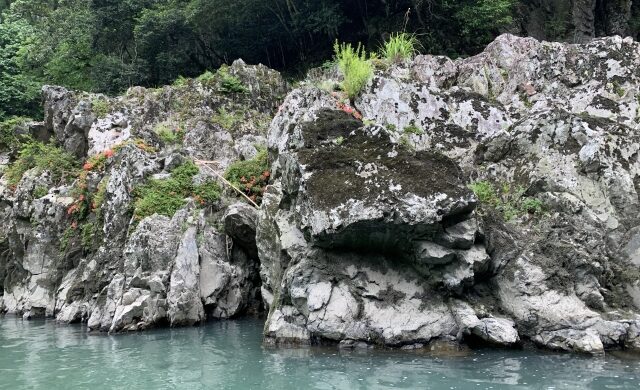
Hozu Gorge is filled
with unusual rock formations.
Some resemble animals,
while others have shapes
that invite the imagination.
One interesting example
is a rock known as Lion Rock.
From a certain angle,
its outline resembles
the profile of a lion.
■ Photo Tip|Finding Shapes in the Rocks
Try photographing
the entire outline of a rock
rather than just its surface.
Its shape may become easier
to recognize.
The Train Above|渓谷を走るトロッコ列車
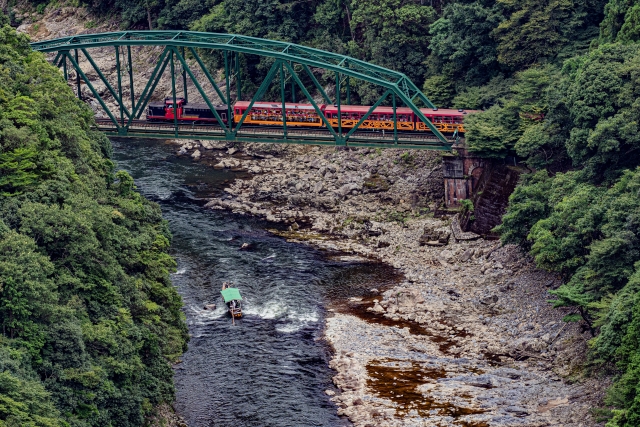
Another memorable sight
is the Sagano Romantic Train.
The railway follows the gorge,
offering views of the river
from the mountainside.
From the boat,
you may see the train
passing high above the river.
Sometimes, passengers
on the train and boat
wave to each other.

■ Photo Tip|A Train Above the River
If the train appears,
try including both
the river and the railway
in your photograph.
The contrast between
the boat and train
shows two different ways
to experience Hozu Gorge.
Changing Seasons|四季の保津峡
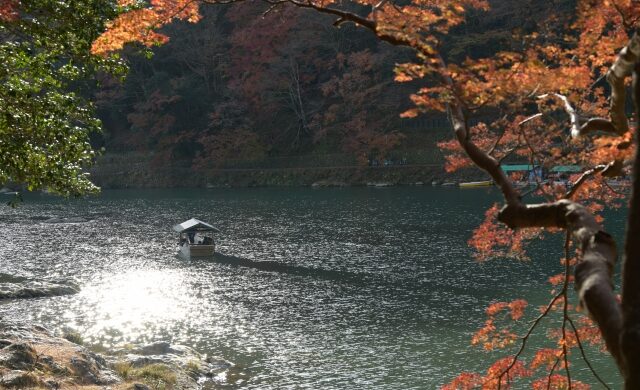
Hozu Gorge changes
with every season.
In spring,
cherry blossoms appear
along the mountainsides.
Early summer brings
fresh green leaves.
In autumn,
the mountains turn
shades of red and gold.
Winter brings bare trees,
clear air,
and sometimes snow.
The river remains the same,
but the scenery around it
continues to change.
■ Memo|A Journey of About 16 km
The journey covers
approximately 16 km
from Kameoka to Arashiyama.
It usually takes
around two hours,
depending on river conditions.
🟫 CAT MEMO 🐾
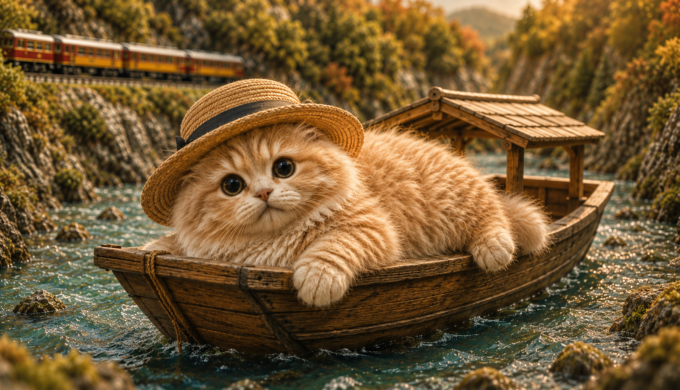
“I got on with no problem!
…But I’m a little scared. 🐾”
🗺 Google Map
Official Website|保津川下り公式ホームページ
Please check the official website
for the latest information before visiting.
From Kameoka to Arashiyama,
the journey offers beautiful views
of Hozu Gorge.
After the boat ride,
Togetsukyo Bridge
and the Bamboo Grove
are waiting to be explored.
Thank you
for visiting
the Hozugawa River Boat Ride.
May your time here
bring you peace
and beautiful memories.
And may your journey
through Kyoto
be a wonderful one. 🐾
🗺 Explore More Kyoto Areas
Kyoto is divided into several unique areas, each offering different attractions and experiences.