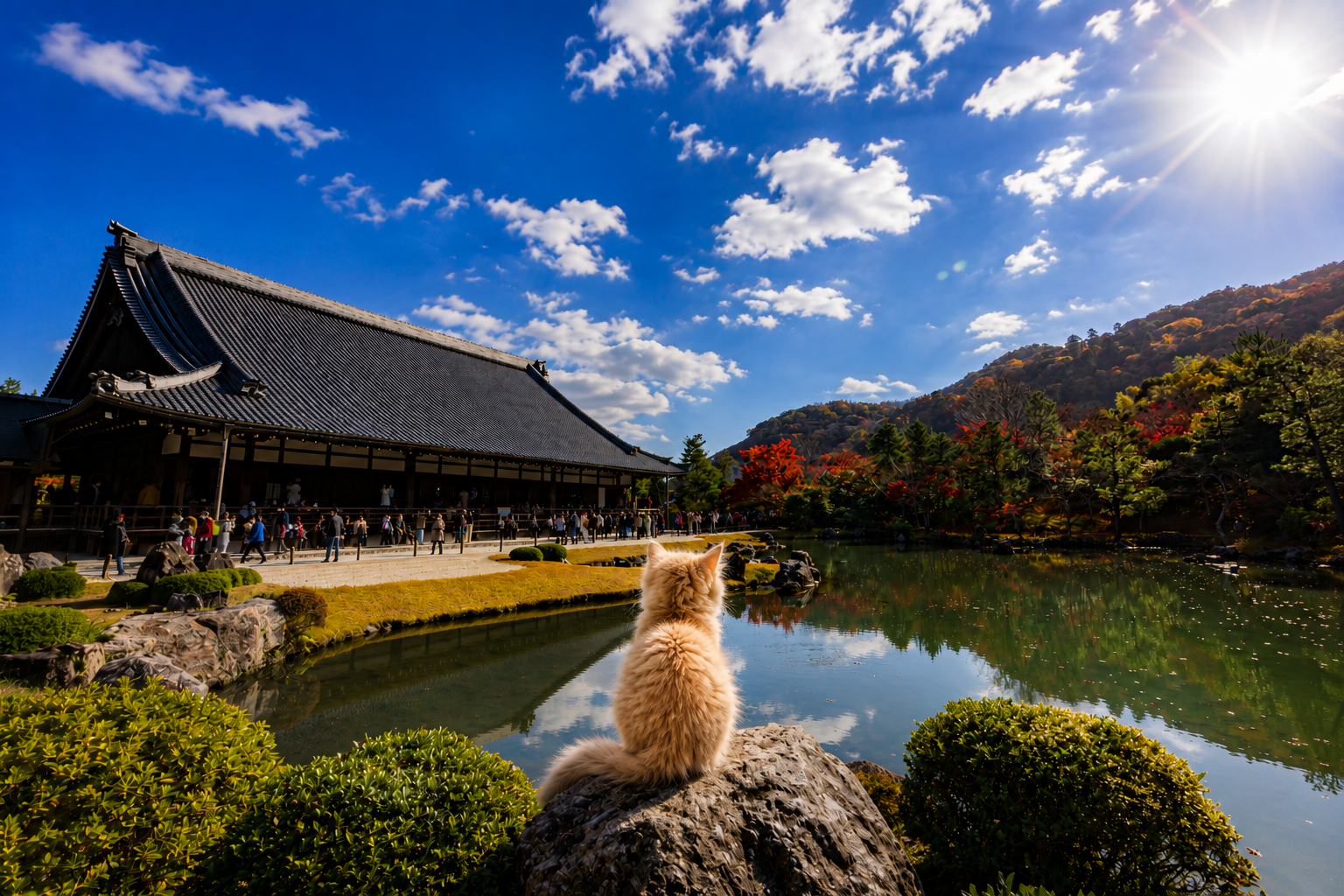
The featured image was AI-generated from a photograph,
with the cat modeled after our family cat.
PR / Ad|This post contains affiliate links.
Read the English + Japanese version|英語+日本語版はこちら
Introduction|はじめに
Tenryu-ji
is one of Kyoto’s
most important Zen temples
and a UNESCO World Heritage Site.
Founded in 1339,
it is the head temple
of the Tenryu branch
of the Rinzai school
of Zen Buddhism.
The temple
is best known
for its beautiful
Sogenchi Garden,
which still preserves
the character
of its original design
from nearly 700 years ago.
Kuri|庫裏
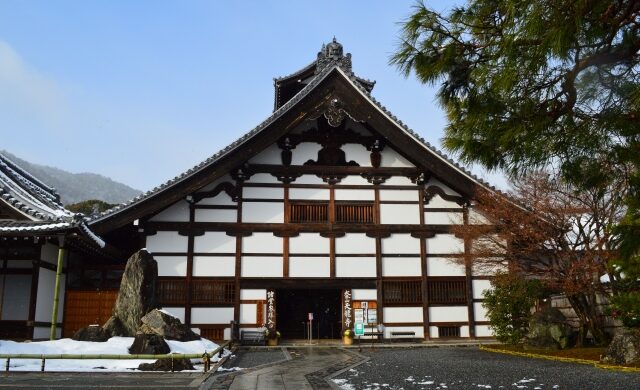
The Kuri
serves as an entrance
to the temple halls
and is one of
Tenryu-ji’s
most recognizable buildings.
Its large gabled roof
and simple wooden architecture
reflect
the quiet beauty
of a Zen temple.
Entering through the Kuri,
visitors begin
their walk
through one of Kyoto’s
most historic temples.
🟫 MINI MEMO
A large Daruma painting
welcomes visitors
inside the Kuri.
Painted by
former head priest
Hirata Seiko,
it symbolizes Zen
and is often described
as one of the faces
of Tenryu-ji.
History|歴史
Tenryu-ji
was founded in 1339
by Ashikaga Takauji,
with the Zen master
Muso Soseki
as its founding abbot.
The temple
was built
to honor
Emperor Go-Daigo
after his death.
The temple’s
famous Sogenchi Garden
was also designed
by Muso Soseki.
Although
the temple buildings
have been rebuilt
after several fires,
the garden
has remained
largely unchanged
since the 14th century.
🟫 MINI MEMO
Tenryu-ji
is ranked first
among the Kyoto Gozan,
the historic
Five Great Zen Temples
of Kyoto.
Daihojo|大方丈
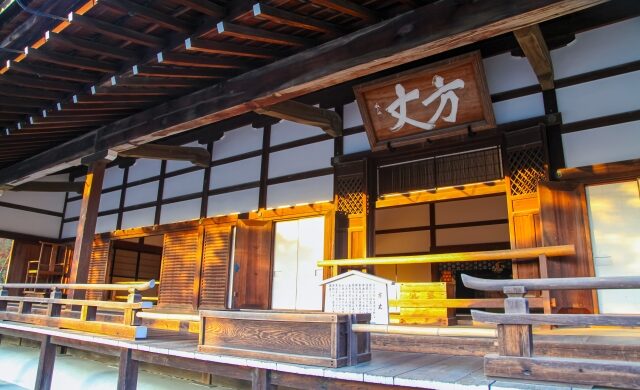
The Daihojo
is the largest hall
at Tenryu-ji.
From its wide wooden veranda,
visitors can enjoy
a full view
of Sogenchi Garden.
The harmony
between the hall
and the surrounding landscape
is one of
the temple’s
most memorable sights.
🟫 MINI MEMO
The principal image
enshrined in the Daihojo
is a seated statue
of Shakyamuni Buddha.
It is the oldest Buddhist statue
remaining at Tenryu-ji.
Sogenchi Garden|曹源池庭園
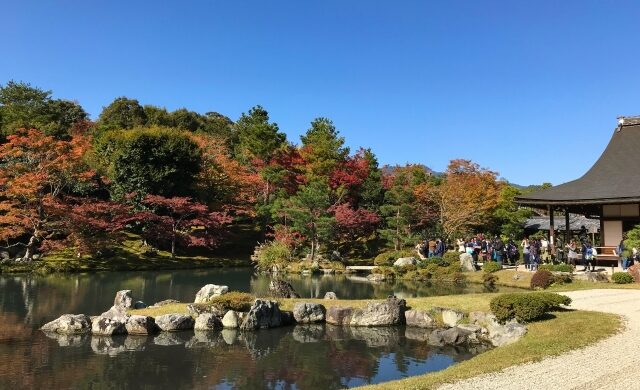
Sogenchi Garden
is the heart
of Tenryu-ji
and its most famous attraction.
The garden
still preserves
much of
its original design
from nearly 700 years ago.
The pond,
stone arrangements,
and surrounding mountains
create
a peaceful landscape
that reflects
the spirit of Zen.
It was the first garden
in Japan
to be designated
both a Historic Site
and a Special Place
of Scenic Beauty.
🟫 PHOTO TIP
The wooden veranda
of the Daihojo
offers one of
the best views
of the entire garden.
From here,
you can photograph
the pond,
stone arrangements,
and surrounding mountains
together.
Garden Details|庭園の見どころ
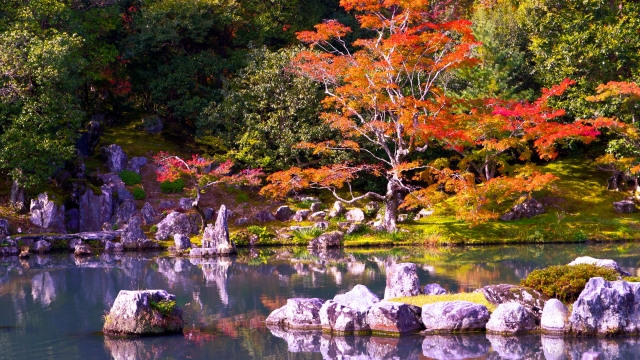
Looking closely,
you will discover
many carefully designed details
throughout the garden.
The stone arrangements,
the large pond,
and the surrounding scenery
each play
an important role
in the overall landscape.
Every element
was thoughtfully placed
to express
the harmony
between nature
and Zen philosophy.
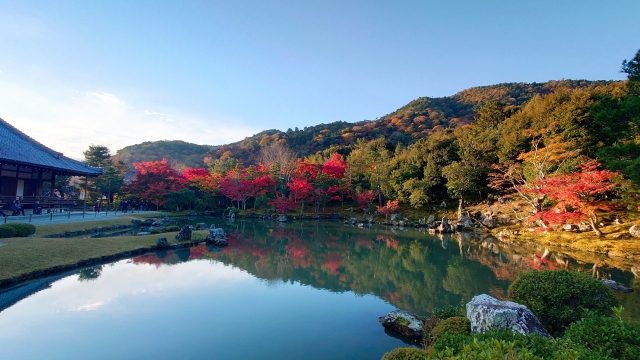
🟫 MINI MEMO
The mountains
behind the garden,
including Arashiyama
and nearby Kameyama,
are incorporated
into the landscape.
This traditional technique
is called
“shakkei,”
or borrowed scenery.
At the center
of the view
from the Daihojo,
a stone arrangement
known as Ryumon-baku
represents
the Chinese legend
of a carp
climbing a waterfall
and becoming a dragon.
Hatto & Cloud Dragon|法堂・雲龍図
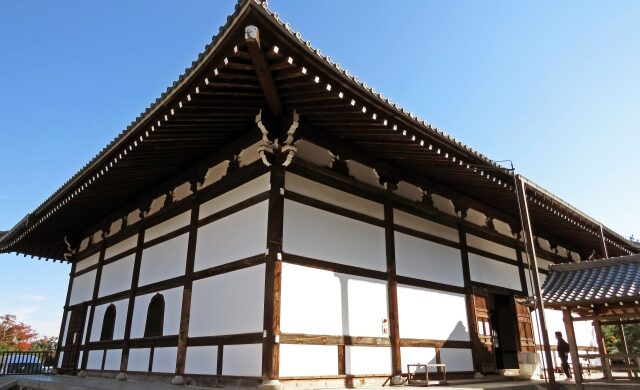
The Hatto
is one of
the main buildings
at Tenryu-ji.
Its ceiling
features
the famous
Cloud Dragon painting,
one of the temple’s
best-known works of art.
The dragon
is designed
to appear
as though
it is watching
visitors
from every direction.
🟫 REAL INFO
The current Cloud Dragon painting
was created in 1997
by Japanese artist
Kayama Matazo.
Outside the special
spring and autumn
viewing periods,
it is generally open
on Saturdays,
Sundays,
and public holidays.
Opening dates
may change
because of temple events,
so check the official website
before visiting.
Wooden Corridors and Verandas|木の廊下と広縁
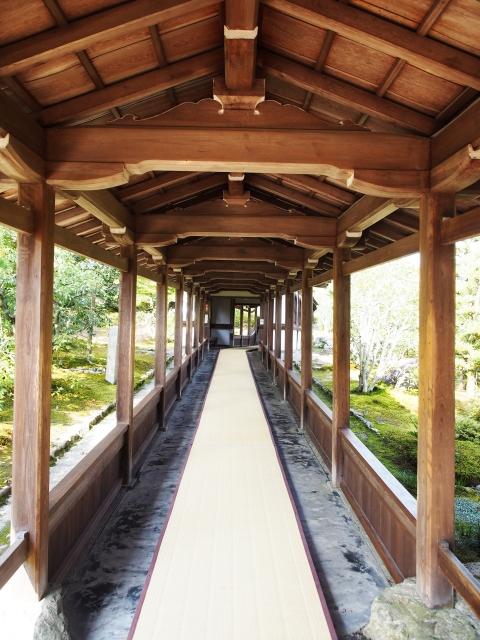
Wooden corridors
and wide verandas
connect the halls
and frame views
of the surrounding gardens.
Soft sunlight
falls across
the wooden floors,
creating a calm atmosphere
throughout the temple buildings.
Walking slowly
through these spaces
offers another way
to experience
the quiet beauty
of Tenryu-ji.
🟫 PHOTO TIP
Take a moment
to look back
toward the garden.
The changing light
creates a different view
throughout the day.
Walking Through the Temple Grounds|境内を歩く

Walking through
the temple grounds,
visitors pass
quiet gardens,
wooded paths,
and peaceful corners
filled with seasonal beauty.
From the north gate,
the path
continues directly
to the famous
Arashiyama Bamboo Grove.
Many visitors
enjoy exploring
both places
during the same walk.
🟫 MINI MEMO
The path through
Hyakka-en Garden
leads to
the north gate.
Beyond the gate,
visitors can continue
toward the Bamboo Grove
and other sights
in the Sagano area.
🟫 CAT MEMO 🐾
“Did it just move?
Or was it my imagination? 🐸”
🗺 Google Map
Tenryu-ji
is a place
where history,
nature,
and Zen
come together.
Take your time
and enjoy
one of Kyoto’s
most peaceful temples.
Thank you for visiting Tenryu-ji.
We hope your visit
becomes
a wonderful memory
of Kyoto. 🐾
🗺 Explore More Kyoto Areas|京都のエリアから探す
Kyoto is divided into several unique areas, each offering different attractions and experiences.