— Notes I Prepared Before Visiting —
Introduction
This page is a pre-visit notebook I put together before going to Tō-ji(東寺).
It is not a record of an actual visit.
When people think of Tō-ji, they often picture the five-storied pagoda rising near Kyoto Station.
But within its grounds, the thought and structure of Esoteric Buddhism quietly breathe.
I wanted to know just a little before walking there.
This is that small preparation.
The Beginning of Tō-ji(東寺)
— The Temple that Guarded the “East” of Heian-kyō —
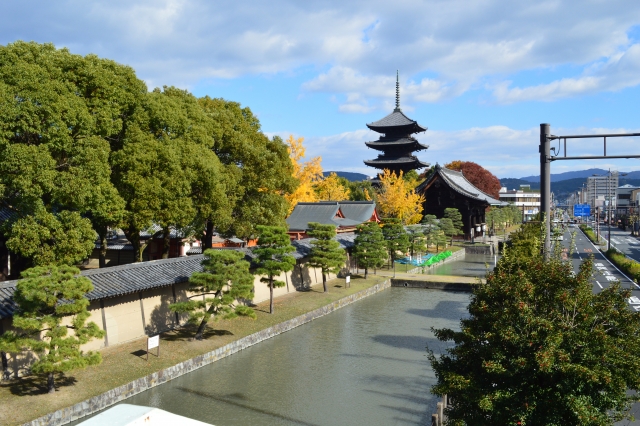
Tō-ji was founded in 796, after the capital was moved to Heian-kyō (ancient Kyoto).
It stood to the east of the former main gate of the capital, Rajōmon. That is why it came to be called “Tō-ji” — the Eastern Temple.
Later, Emperor Saga entrusted the temple to Kūkai (空海).
Kūkai was the monk who established Shingon Buddhism (真言宗) in Japan.
From that point on, Tō-ji became the central training temple of Shingon Esoteric Buddhism.
In 1994, it was registered as part of the UNESCO World Cultural Heritage site “Historic Monuments of Ancient Kyoto.”
The Gates of Tō-ji(東寺の門)
— A Structure that Draws You Toward the Center —
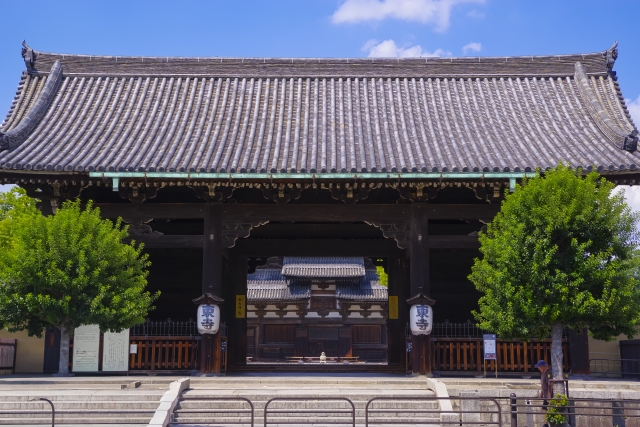
Tō-ji has several gates.
The main Southern Gate (Nandaimon). Inside it, the Middle Gate (Chūmon). To the east, the East Gate. And also Keigamon.
The grounds are not one single open space.
You pass through one gate, and then another.
Step by step, you move closer to the center.
After passing the Southern Gate, your view opens, and the pagoda appears.
After passing the Middle Gate, you enter the space of the Kondō (金堂) and Kōdō (講堂).
From outside to inside. From an open space toward the center of thought.
Tō-ji does not reveal everything at once.
It is a temple that guides you inward, gradually.
The Five-Storied Pagoda(五重塔)
— A Vertical Prayer Connecting Earth and Sky —
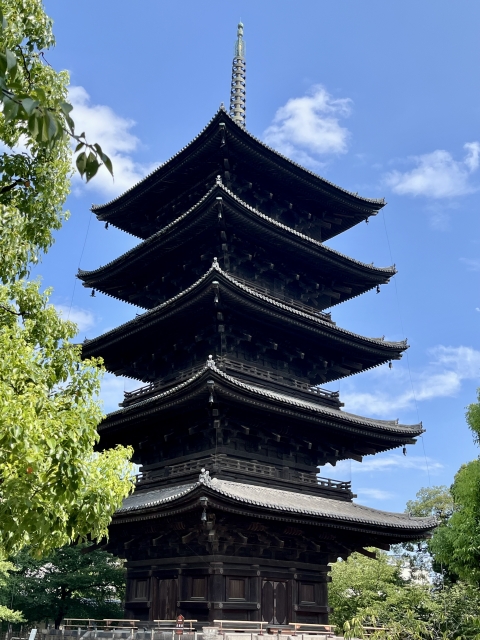
Approximately 55 meters high.
It is the tallest wooden five-storied pagoda in Japan.
The current structure was rebuilt in 1644. It has been lost and rebuilt multiple times due to lightning strikes and fire.
Inside the pagoda runs a central pillar called the shinbashira(心柱), with Buddhist statues arranged around it.
At the center is Dainichi Nyorai(大日如来).
The five tiers symbolize the five elements: earth, water, fire, wind, and void.
In other words, this tower is not only an impressive structure in height, but also a vertical expression of the cosmology of Esoteric Buddhism.
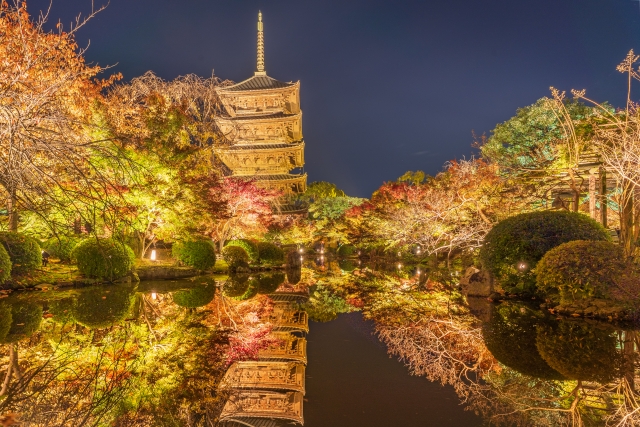
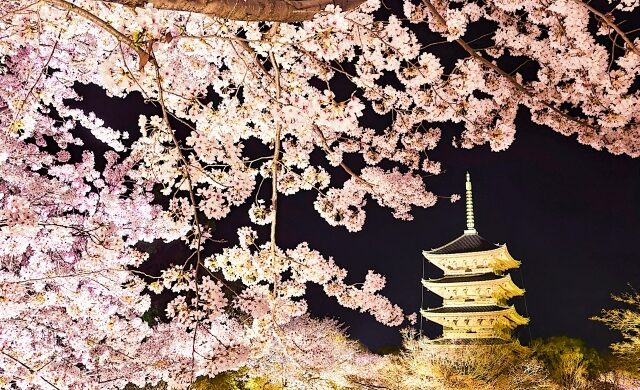
During cherry blossom season, and especially during the autumn night illuminations, the reflection of the pagoda in the pond becomes unforgettable.
At night, it is not only the tower that rises from the darkness. Together with its reflection on the water, it forms a single composition.
The layered image above and below creates a quiet symmetry.
Kondō(金堂)
— Where the Principal Deity Resides —
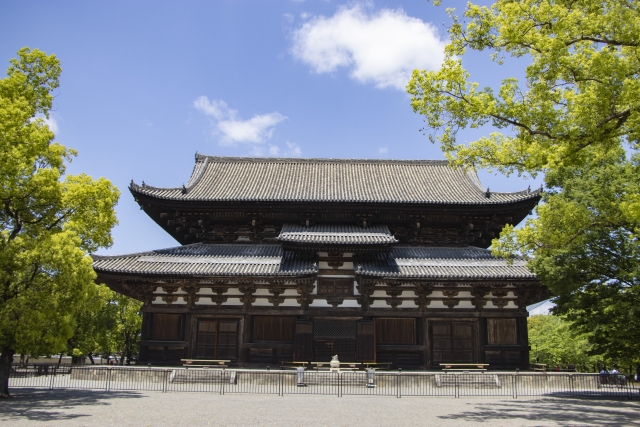
The principal image is Yakushi Nyorai(薬師如来), flanked by Nikko and Gakkō Bodhisattvas.
If the pagoda is a symbol stretching upward, the Kondō is a place of prayer closer to the earth.
It is a space where human wishes are quietly placed.
Kōdō(講堂)
— A Three-Dimensional Mandala —
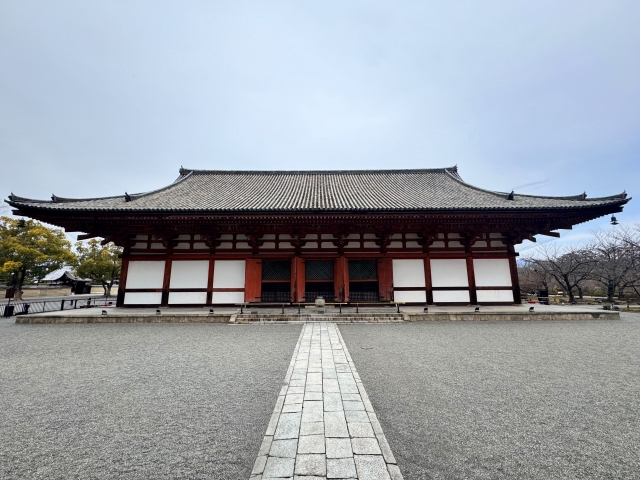
Inside the Kōdō, 21 Buddhist statues are arranged.
At the center stands Dainichi Nyorai(大日如来).
Around him are Buddhas, Bodhisattvas, and Wisdom Kings.
This is a three-dimensional mandala.
In Esoteric Buddhism, Dainichi Nyorai represents the universe itself.
From the center, wisdom and compassion expand outward.
Here, it may feel less like “looking at statues” and more like standing inside the structure of the cosmos.
If the pagoda is a symbol viewed from outside, the Kōdō is thought entered from within.
The core of Tō-ji lies here.
Mieidō(御影堂)
— The Hall Dedicated to Kōbō Daishi —
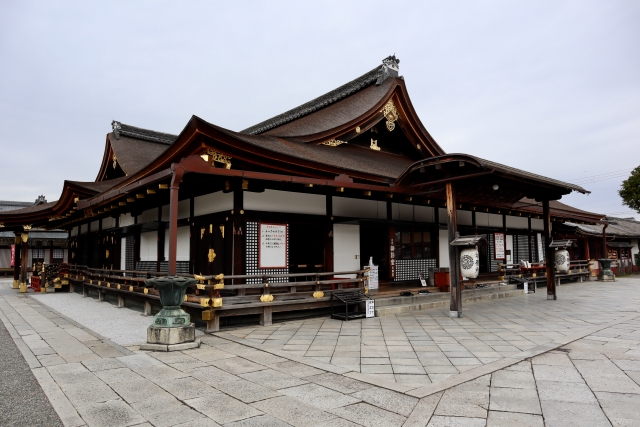
This hall enshrines Kōbō Daishi(弘法大師), another name for Kūkai.
Tō-ji is not only a historical monument.
It remains a living place of faith.
Here, more than a tourist site, you quietly sense it as a place of prayer.
Words You Often See at Tō-ji(東寺でよく見る言葉)
■ Shingon-shū(真言宗)
The esoteric Buddhist school founded by Kūkai.
■ Mikkyō(密教)
A form of Buddhism that expresses ultimate truth through symbols and ritual.
■ Dainichi Nyorai(大日如来)
The Buddha who represents the universe itself.
■ Mandala(曼荼羅)
A diagram or spatial arrangement expressing the structure of the cosmos.
■ Godai(五大)
The five elements: earth, water, fire, wind, and void.
■ Shinbashira(心柱)
The central pillar running through a pagoda.
Basic Information 📍
◎ Address
1 Kujo-cho, Minami-ku, Kyoto City, Kyoto, Japan
京都府京都市南区九条町1番地
◎ Opening Hours
Grounds: 5:00 AM – 5:00 PM
Paid area (Kondō & Kōdō): 8:00 AM – 5:00 PM (last admission 4:30 PM)
(Seasonal night special viewings may be held. Please check the official site.)
◎ Admission
The Kondō and Kōdō area requires an entrance fee.
◎ Official Website
https://toji.or.jp/
*Please check the official site for the latest information.*
Closing Thoughts
The five-storied pagoda immediately catches the eye.
But Tō-ji is not only about height.
The structure of the mandala, the thought of Esoteric Buddhism, and the prayers that continue even now.
If you know just a little before walking there, the pagoda may look slightly different.
I hope this small notebook becomes a gentle preparation for your visit.

コメント