― Notes I Prepared Before Visiting ―
Introduction
This page is a pre-visit notebook I put together before visiting Kiyomizu-dera ( 清水寺 ), one of the temples many people first think of when they hear “Kyoto.”
It is not a record of an actual visit.
But as I researched its history, architecture, and main highlights,
I found myself thinking,
“I want to walk here after truly understanding it.”
When people search for “Kyoto temples,”
Kiyomizu-dera is often one of the first names that appears.
That is exactly why I do not want to walk through it vaguely.
In this notebook, you will find
the history of the temple,
its main highlights within the grounds,
and practical information for visiting.
I want to know just a little before I go.
This is that small preparation.
The Beginning of Kiyomizu-dera
— A Temple That Began with Pure Water —
Kiyomizu-dera is said to have been founded in 778, during the Nara period.
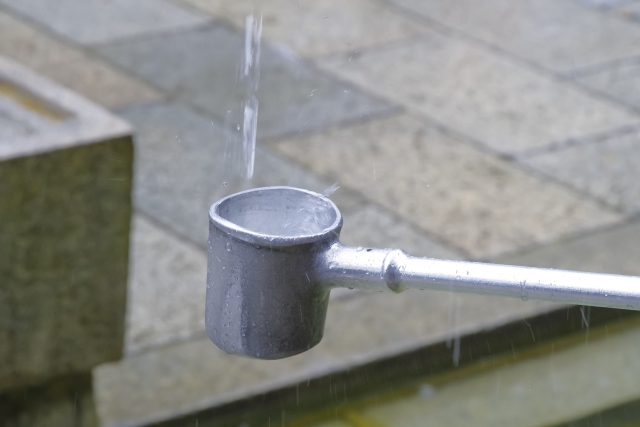
The temple’s name comes from the pure water that flows from Mount Otowa ( 音羽山 ).
It began when a small hermitage was built in search of that water.
Many of the current buildings
were reconstructed in the early Edo period (1633)
after repeated fires.
Kiyomizu-dera is a Buddhist temple
whose principal deity is Kannon Bodhisattva ( 観音菩薩 ).
Although it is widely known for its breathtaking views,
at its center lies devotion to Kannon.
In 1994, it was inscribed on the UNESCO World Heritage List
as part of the “Historic Monuments of Ancient Kyoto.”
Today, it remains one of the most visited and historically significant temples in Japan.
Main Highlights Within the Grounds
Here are the main places you may wish to see when visiting Kiyomizu-dera:
• Niōmon Gate ( 仁王門 )
• Three-storied Pagoda ( 三重塔 )
• Main Hall ( 本堂 )
• Kiyomizu Stage ( 清水の舞台 )
• Otowa Waterfall ( 音羽の滝 )
• Sutra Hall ( 経堂 )
• Zuigudō Hall ( 随求堂 )
• West Gate ( 西門 )
They are not isolated attractions,
but arranged along a natural flow of worship.
Niōmon Gate ( 仁王門 )
— A Gate That Protects the Boundary —
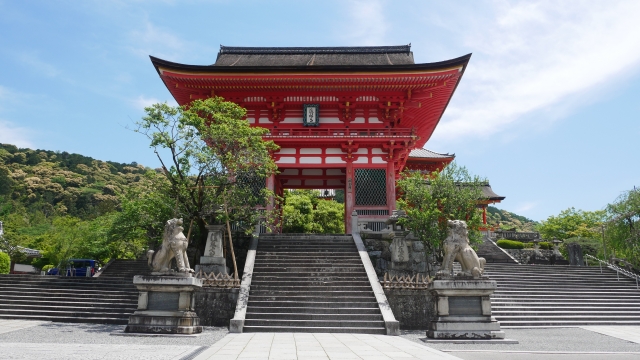
The Niōmon Gate stands at the entrance of Kiyomizu-dera.
The current structure is believed to date from the late Muromachi period.
(15th–16th century)
The temple has suffered many fires,
and the gate too has been reconstructed over time.
What Are the Niō Guardians ( 仁王像 )?
On either side of the gate stand powerful guardian statues.
They are protectors of the Buddhist teachings,
guardians of the boundary between
the sacred precinct and the outside world.
Agyō and Ungyō ( 阿形と吽形 )
The two statues form a pair.
• The open-mouthed figure — Agyō
• The closed-mouthed figure — Ungyō
“A” represents the beginning.
“Un” represents the end.
Together, they symbolize
the beginning and end of the universe,
the inhale and exhale of breath.
Visitors pass between them
as they enter the temple grounds.
Architecture and Color
The gate is built in irimoya-style architecture
with a two-storied structure.
Its thick pillars and deep eaves create a powerful presence.
The vivid vermilion color
is said to ward off evil
and marks the boundary of sacred space.
Three-Storied Pagoda ( 三重塔 )
— A Vertical Axis of Prayer —
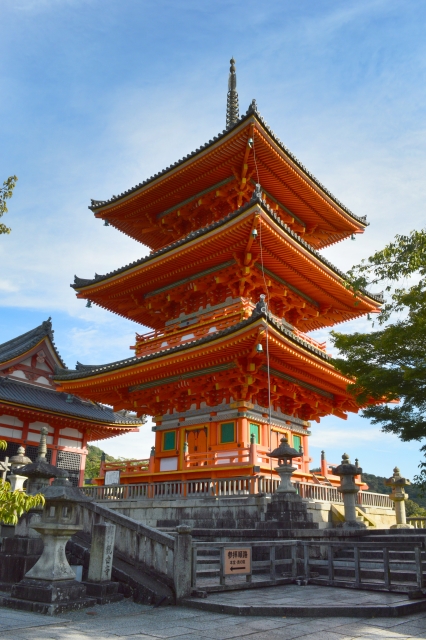
The current pagoda was rebuilt
in the late Muromachi period.
It stands about 31 meters tall,
making it the tallest structure in the temple grounds.
Structure
It has three layered roofs.
At its center runs a main pillar called the “shinbashira.”
This central pillar stabilizes the structure
and helps it withstand earthquakes.
The interior is largely hollow,
designed to distribute weight efficiently.
Meaning in Buddhism
Pagodas originally housed sacred relics of the Buddha.
Over time, they came to symbolize the universe itself:
Earth, Water, Fire, Wind, and Space.
The pagoda serves as a vertical axis within the temple grounds.
Main Hall ( 本堂 )
— The Heart of Kiyomizu-dera —
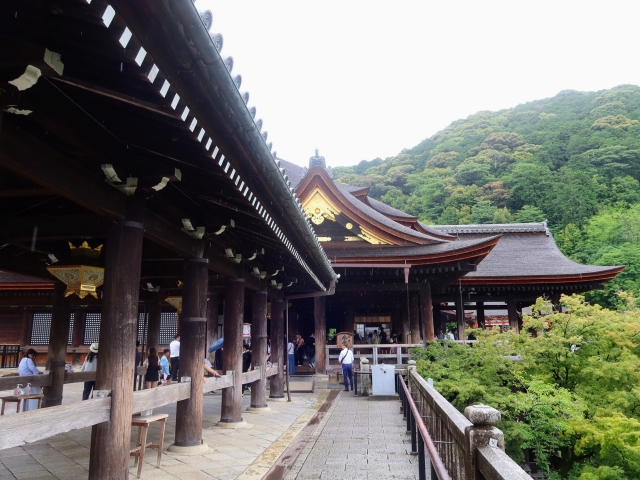
The current Main Hall was rebuilt in 1633
through the donation of Tokugawa Iemitsu ( 徳川家光 ).
Inside is enshrined the temple’s hidden principal image:
the Eleven-Faced Thousand-Armed Kannon ( 十一面千手観音菩薩 ).
It is not normally open to the public.
The center of Kiyomizu-dera is not the view —
it is prayer.
Joining your hands in front of the Main Hall
is the essence of worship here.
Kiyomizu Stage ( 清水の舞台 )
— A Structure That Expands the Space of Worship —
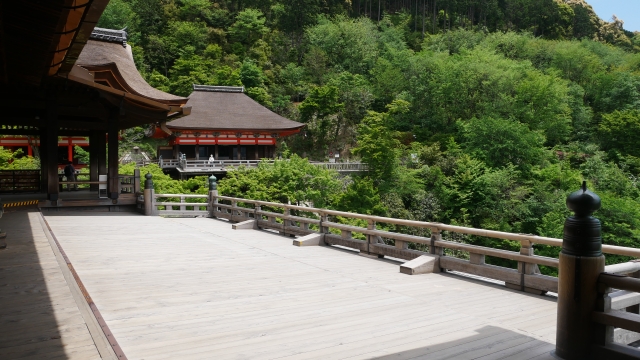
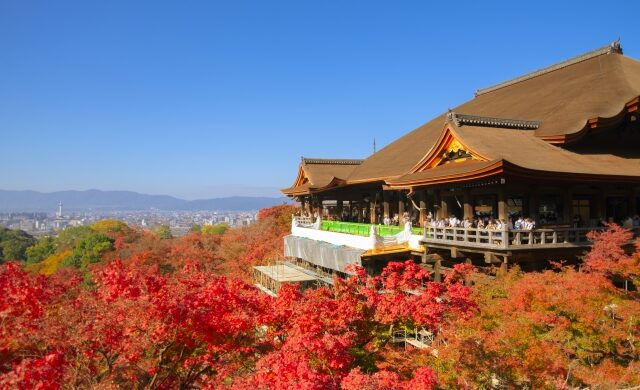
The famous wooden stage, often called the “Kiyomizu Stage,” extends from the Main Hall.
It is one of the most photographed and iconic structures in Kyoto.
Height: approximately 13 meters
Width: approximately 18 meters
Floor area: about 200 square meters
It stands on 18 large keyaki (zelkova) pillars,
each about 50 centimeters in diameter.
The construction method is called “kake-zukuri,”
built along the mountain slope without leveling the land.
The stage was not created as a viewing platform.
It was built to widen the space
for worshiping Kannon.
The panoramic view of Kyoto
is a result of expanding prayer space.
Special Night Viewing
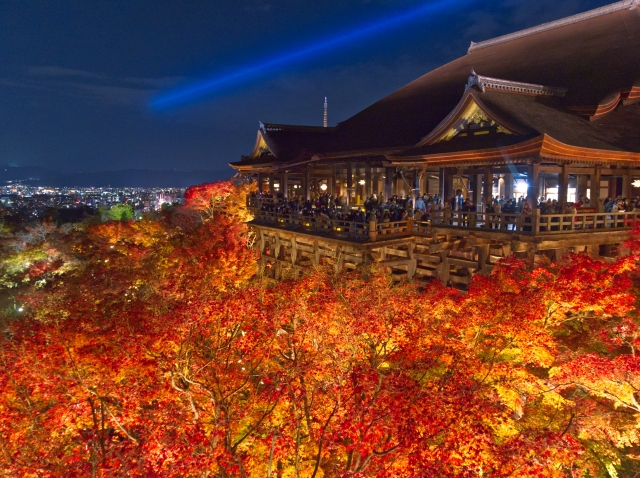
Special night openings are held
in spring, summer, and autumn.
The illuminated Main Hall and stage
create a different atmosphere from daytime.
Yet even at night,
it remains a place of prayer.
Otowa Waterfall ( 音羽の滝 )
— The Origin of the Temple —
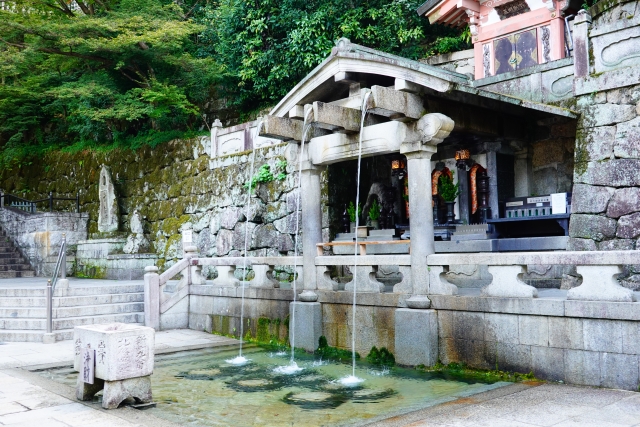
At the base of the Main Hall flows Otowa Waterfall.
The water splits into three streams.
They are said to symbolize:
• Academic success
• Love
• Longevity
Many visitors line up here to drink from the three streams of sacred water.
But originally,
this was a place to purify body and mind
with clear water.
The name “Kiyomizu” (pure water)
comes from here.
The stage is often spoken of as the symbol,
but the true origin of the temple
is this water.
Sutra Hall ( 経堂 )
— A Building That Preserves Words —
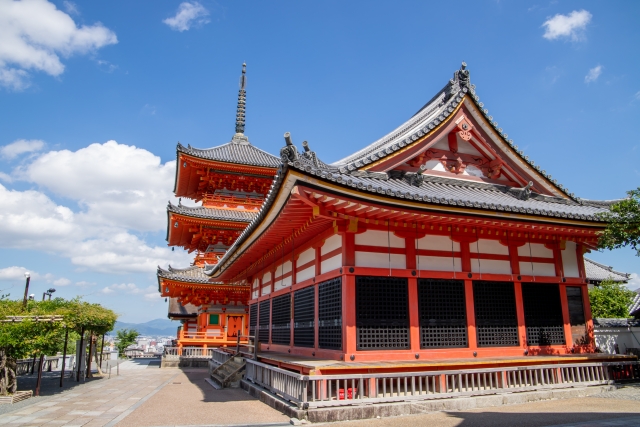
The Sutra Hall houses sacred scriptures.
Buddhist teachings were passed down
not only orally,
but also in written form.
This building exists
to protect those words.
Prayer may be invisible,
but its teachings remain
through preserved text.
Zuigudō Hall ( 随求堂 )
— A Journey Inward —
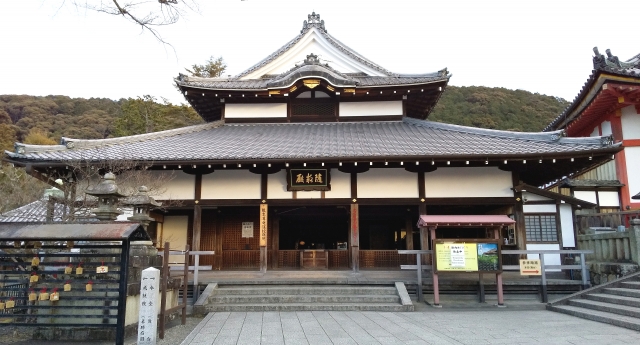
At Zuigudō, visitors can experience
“Tainai Meguri ( 胎内めぐり )” (womb pilgrimage).
In complete darkness,
you walk while holding a rosary rope.
This space is said to symbolize
the world before birth.
While the stage opens outward,
Zuigudō turns inward.
It is a place
not to look over the city,
but to face oneself.
West Gate ( 西門 )
— Sunset and the Pure Land —
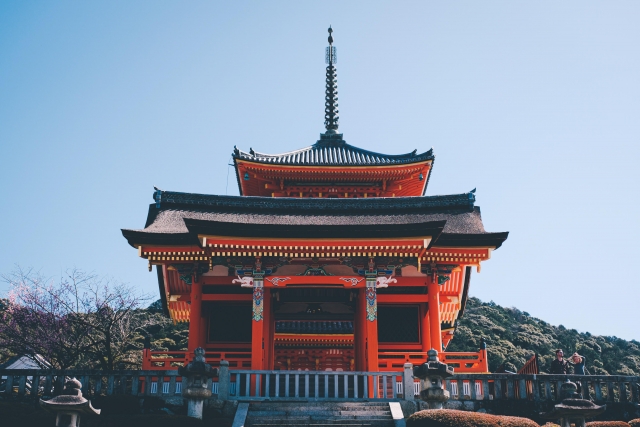
The West Gate is associated
with the Western Pure Land.
In Buddhism,
Amida Buddha’s paradise ( 阿弥陀如来 )
is believed to lie in the west.
Watching the sun set
was once seen
as contemplating the Pure Land.
Sunset is not only an ending,
but a quiet reminder
of another world beyond.
A Small Note, Before You Go
— A Place of Prayer —
Kiyomizu-dera(清水寺) is a Buddhist temple.
Before you walk further,
just remember one thing.
This is a place of prayer.
In the Main Hall,
remove your hat,
join your palms quietly,
and do not clap.
That is enough.
Words Frequently Seen at Kiyomizu-dera
■ Saigoku Thirty-Three Kannon Pilgrimage ( 西国三十三所 )
A pilgrimage route devoted to Kannon Bodhisattva. Thirty-three temples are designated across the Kansai region, and Kiyomizu-dera is the 16th temple on this route. It is part of a pilgrimage tradition that has continued since the Heian period.
■ Kannon Sacred Site ( 観音霊場 )
A temple whose principal deity is Kannon Bodhisattva. Kiyomizu-dera has long been a central place of Kannon devotion. Before the famous view, there was a long history of prayer.
■ Fudasho ( Pilgrimage Temple )( 札所 )
A temple visited as part of a pilgrimage. Pilgrims receive proof of worship such as stamped slips or goshuin (御朱印). Kiyomizu-dera(清水寺) is an official temple of the Saigoku pilgrimage.
■ Goeika ( Pilgrimage Hymn )( 御詠歌 )
A devotional verse chanted during pilgrimage. Each temple, including Kiyomizu-dera(清水寺), has its own goeika. It is a uniquely Japanese tradition of placing prayer into poetic words.
■ Hibutsu ( Hidden Buddha )( 秘仏 )
A Buddhist statue that is not normally shown to the public. The principal image of Kiyomizu-dera(清水寺), the Eleven-Faced Thousand-Armed Kannon(十一面千手観音菩薩), is a hibutsu. It is revealed only on special occasions. The very fact that it is unseen is considered part of the faith.
■ Naijin ( Inner Sanctuary )( 内陣 )
The most sacred space where the principal image is enshrined. General visitors are not permitted to enter. It is the center of prayer within the hall.
■ Gejin ( Outer Sanctuary )( 外陣 )
The space where visitors stand to worship. The area where we pray in the Main Hall(本堂) is the gejin. From there, we quietly face the naijin(内陣).
■ Ekō ( Dedication of Merit )( 回向 )
A prayer in which one dedicates the merit of good deeds not only for oneself, but also for others or for ancestors. It is an important concept in Buddhism.
■ Kiyomizu-style Architecture ( 清水型建築 )
A large-scale architectural style represented by the Kiyomizu Stage(清水の舞台). Its bold structure extends over the mountain slope without flattening the land. This style influenced later architecture as well. The expression “to jump from the stage of Kiyomizu” originated from this structure.
Basic Information 📍
The following details may help you plan your visit to Kiyomizu-dera.
◎ Address
1-294 Kiyomizu, Higashiyama-ku,
Kyoto City, Kyoto, Japan
京都府京都市東山区清水1丁目294
◎ Opening Hours
6:00 a.m. – 6:00 p.m.
(Closing time varies by season.)
◎ Special Night Viewing
Held in spring, summer, and autumn (limited periods)
For specific dates and the latest updates, please refer to the official website.
◎ Admission (Main Hall)
Adults: 500 yen
Children (elementary & junior high): 200 yen
*As of 2026
◎ Official Website
For the latest updates, please check the official website below:
https://www.kiyomizudera.or.jp/en/
Closing Thoughts
Architecture that merges with the mountain.
A stage stretching outward.
A pagoda reaching upward.
A temple that began with water.
When you know just a little,
what you see may quietly change.
Whether you are visiting for its history, its architecture, or its quiet atmosphere,
knowing just a little may gently change what you see.
I hope this notebook becomes a small preparation for you.
Thank you for reading.
コメント