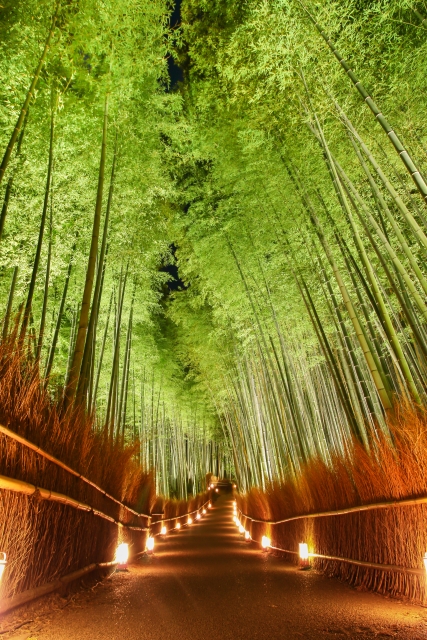
— A Path Surrounded by Bamboo —
- Introduction
- What Is the Bamboo Grove Path
- The History of Sagano and Bamboo
- The Structure of the Bamboo Landscape
- The Bamboo Grove Is Not Completely Wild
- The Sound of the Bamboo Grove
- Helpful Japanese Words (Arashiyama Bamboo Grove)
- Helpful Japanese Words for Kyoto Nature Walks
- Basic Information
- Closing Thoughts
Introduction
This page is a small preparation note
I wrote before walking through the Arashiyama Bamboo Grove.
It is not a record of an actual visit.
When people think of Arashiyama,
many imagine the view of Togetsukyo Bridge.
But just a little north of there,
there is a completely different landscape.
A path where bamboo covers the sky.
A place where light falls in thin lines.
As I looked at photos and read about it,
this place began to feel like something more
than simply “a place with a lot of bamboo.”
A landscape that has taken shape over a long time.
That is how it started to appear to me.
I wanted to know just a little before walking there.
So this page is a small preparation for that walk.
What Is the Bamboo Grove Path
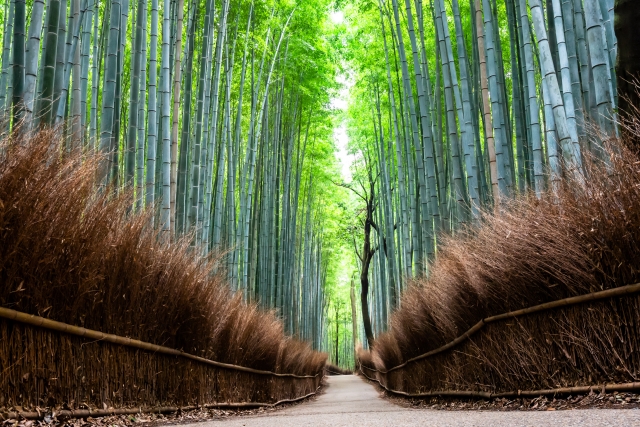
The Bamboo Grove Path is a walking trail
located in Sagano, Kyoto.
It runs from the north side of Tenryu-ji Temple
toward the Sagano area.
The path is about 400 meters long.
It takes only around ten minutes to walk,
but it is known as one of the most iconic landscapes in Arashiyama.
Overseas, it is often introduced as
Arashiyama Bamboo Grove
and is widely recognized as one of the symbolic scenes of Kyoto.
It is located just north of Tenryu-ji Temple and near Nonomiya Shrine.
The History of Sagano and Bamboo
Sagano has long been known
as a region where bamboo grows abundantly.
The bamboo commonly found here
is a variety called Madake.
Madake bamboo has traditionally been used for many things,
such as:
• bamboo crafts
• farming tools
• building materials
In other words, the bamboo groves of Arashiyama
were not originally created for tourism.
Rather, they were bamboo forests cultivated as part of daily life.
Over time,
those groves remained as part of the landscape,
eventually becoming the scenery we see in Arashiyama today.
The Structure of the Bamboo Landscape
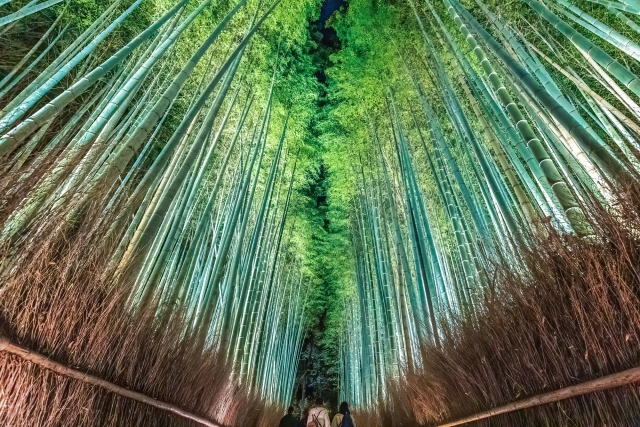
There are several features
that shape the scenery of the bamboo grove.
First,
bamboo is not a tree that spreads sideways.
It grows straight upward.
In Sagano,
some bamboo grows to a height of about
15 to 20 meters.
Because of that,
when you step into the grove,
your gaze naturally moves upward.
The sky begins to look narrow,
creating a unique atmosphere.
Rather than a forest,
it feels like a corridor surrounded by bamboo pillars.
The Bamboo Grove Is Not Completely Wild
If left alone,
bamboo spreads rapidly.
For that reason,
the bamboo grove in Arashiyama
is still carefully managed today.
Work such as:
• thinning bamboo
• clearing fallen bamboo
• maintaining the walking paths
is regularly carried out.
Bamboo grows extremely fast,
sometimes several meters in just a few months.
Without management,
the grove would become too dense,
and the clear landscape we see today would disappear.
The bamboo grove of Arashiyama is therefore
a natural landscape,
but also a landscape protected by human hands.
The Sound of the Bamboo Grove
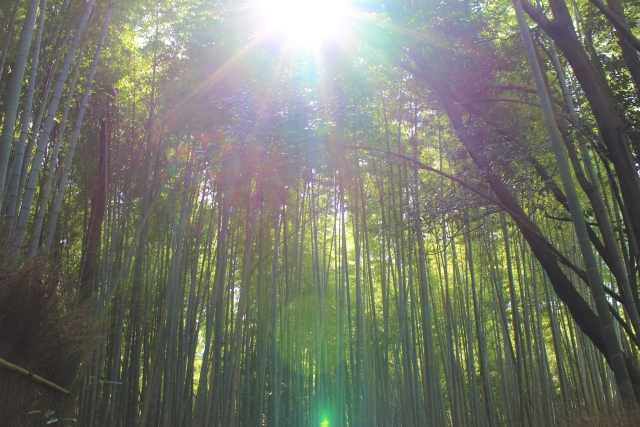
When the wind blows,
bamboo makes sound.
Leaves touching each other.
Bamboo swaying gently in the wind.
The Arashiyama bamboo grove
is often introduced as a place
where the sound of bamboo
is also part of the experience.
It may be another kind of landscape
that cannot be seen in photographs.
The sound of the Sagano bamboo grove
was also selected as one of Japan’s
“100 Soundscapes” by the Ministry of the Environment.
Helpful Japanese Words (Arashiyama Bamboo Grove)
- 竹林(ちくりん)— Chikurin (Bamboo Grove)
A place where bamboo grows densely together.
The Sagano area of Kyoto has long been known for its bamboo groves. - 竹林の小径(ちくりんのこみち)— Chikurin no Komichi (Bamboo Grove Path)
The famous walking path that runs through the bamboo forest
from the north side of Tenryu-ji Temple toward Sagano. - 真竹(まだけ)— Madake (Japanese Timber Bamboo)
A common species of bamboo found in Sagano.
It has traditionally been used for bamboo crafts,
farming tools, and building materials. - 嵯峨野(さがの)— Sagano
The quiet area north of Arashiyama.
It is known for temples, bamboo groves, and traditional landscapes. - 竹の音(たけのおと)— Sound of Bamboo
The gentle sound created when wind moves through bamboo leaves.
In Arashiyama, this sound is considered part of the landscape itself. - 竹垣(たけがき)— Takegaki (Bamboo Fence)
Traditional fences made from bamboo,
often seen along paths in Kyoto gardens and bamboo groves.
Helpful Japanese Words for Kyoto Nature Walks
- 小径(こみち)— Komichi
A small walking path or narrow lane.
Often used to describe quiet paths through gardens or forests. - 散策(さんさく)— Sansaku
A gentle walk taken for enjoyment or reflection,
rather than for reaching a destination. - 景観(けいかん)— Keikan
The visual character of a place,
including natural scenery and human design. - 静けさ(しずけさ)— Shizukesa
A quiet atmosphere or stillness.
Many traditional landscapes in Kyoto are appreciated for this quality. - 自然景観(しぜんけいかん)— Natural Landscape
A scenery shaped by nature,
sometimes gently maintained by human care.
Basic Information
Arashiyama Bamboo Grove
📍 Location
Sagano area, Ukyo Ward, Kyoto, Japan
🚶 Access
About a 10-minute walk from Arashiyama Station
🕒 Opening Hours
Open 24 hours
💰 Admission
Free
Closing Thoughts
The Bamboo Grove Path
is widely known as one of the most iconic landscapes in Arashiyama.
But the grove itself
is also something that has been cultivated
over a long period of time.
A scenery shaped by both
nature
and human care.
Thinking about that,
the bamboo path may begin
to look a little different.
Someday, when I walk there,
I hope to quietly feel those layers of time.
コメント