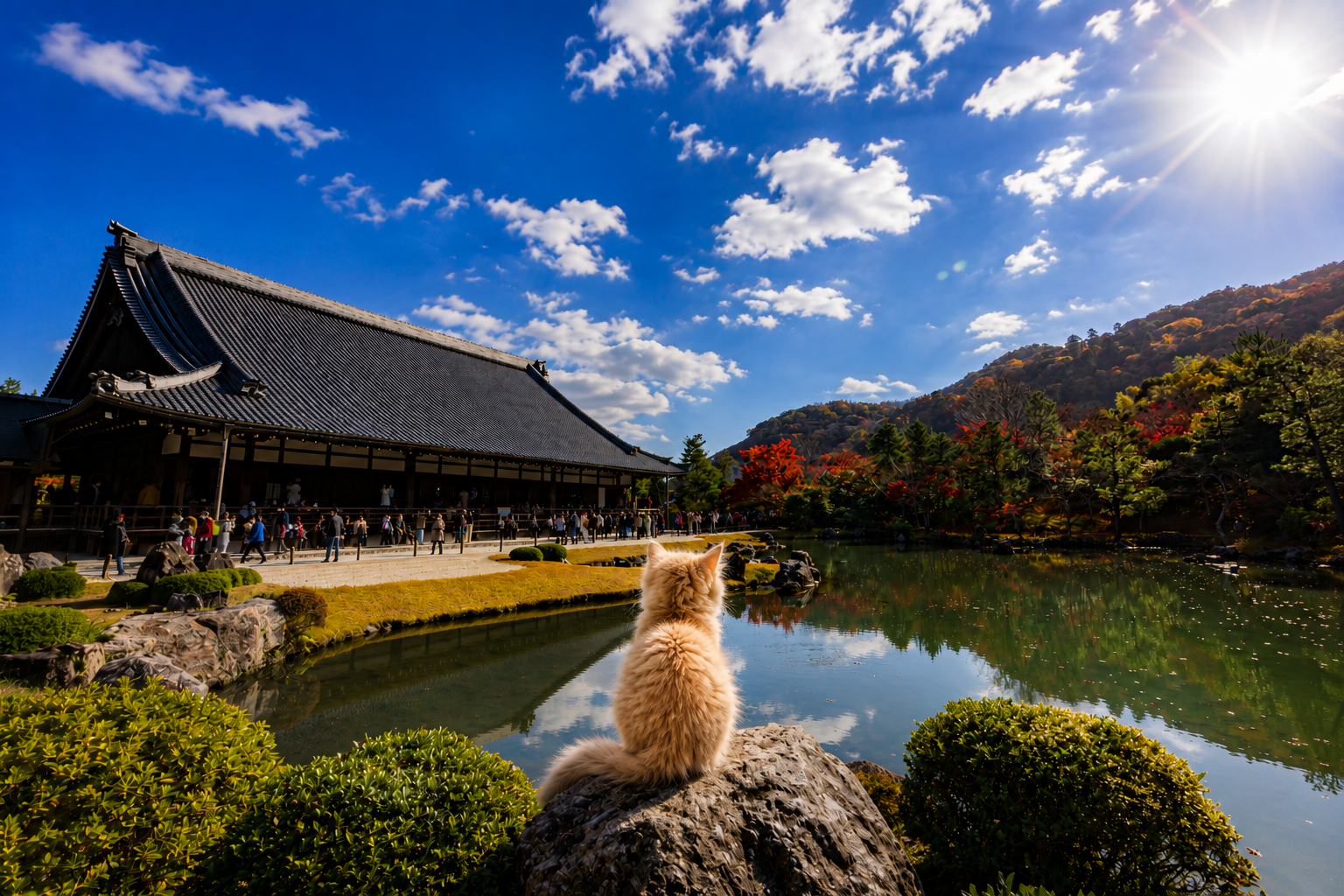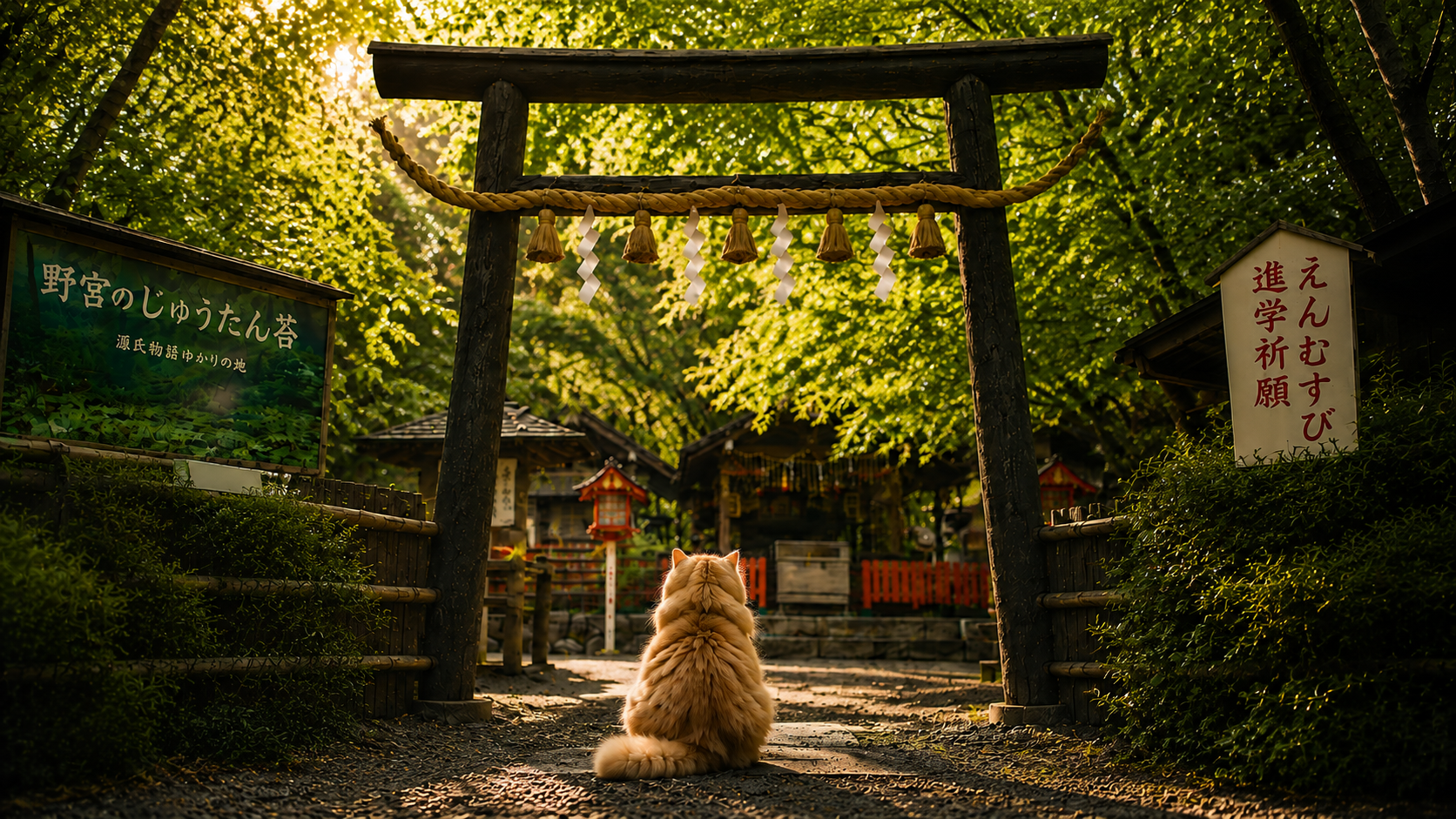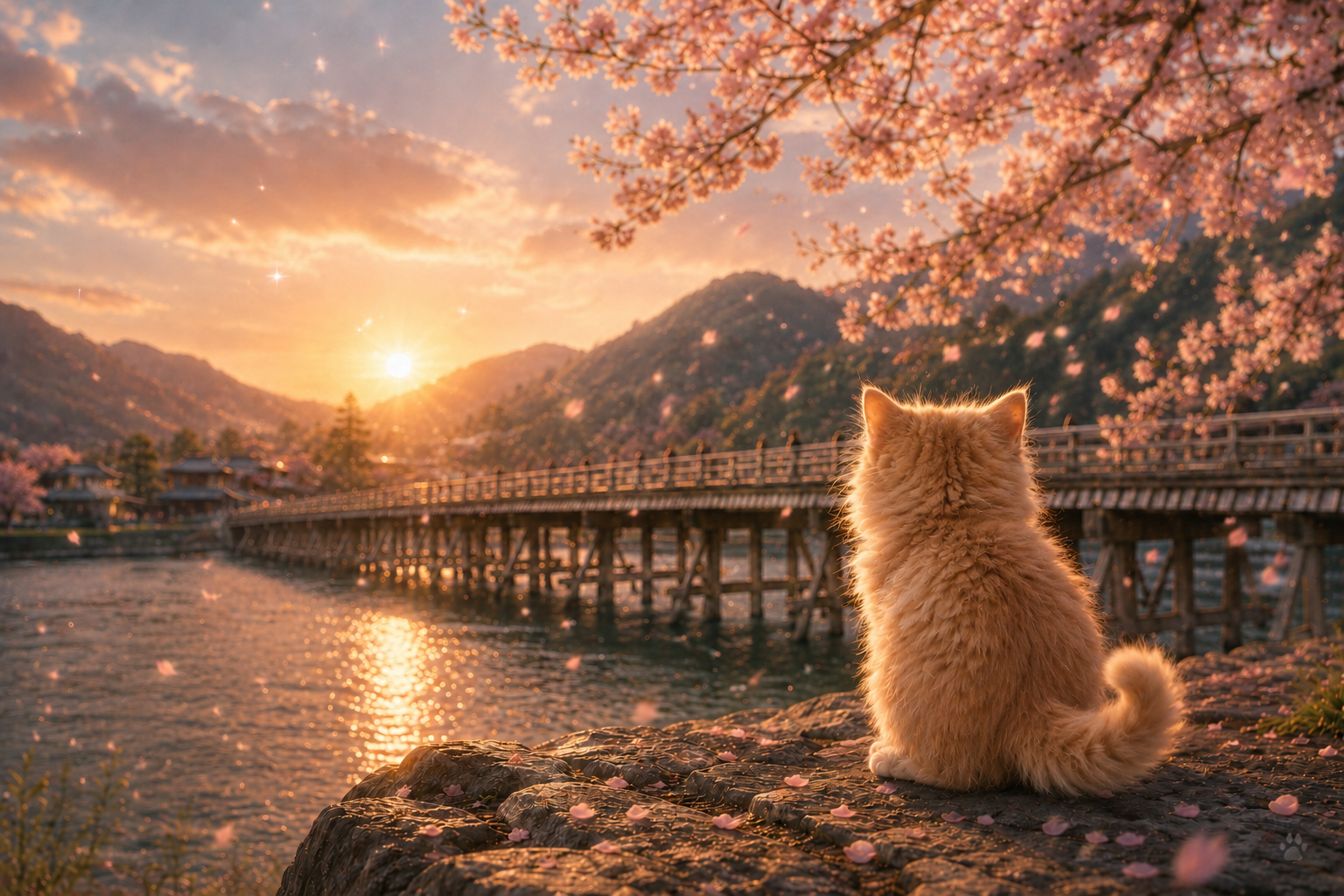
The featured image was AI-generated from a photograph,
with the cat modeled after our family cat.
PR / Ad|This post contains affiliate links.
Read the English + Japanese version|英語+日本語版はこちら
- Introduction|はじめに
- History|歴史
- Walking Across Togetsukyo Bridge|渡月橋を歩く
- Bridge Entrance & Name Marker|橋のたもと・橋名柱
- Bridge Structure|橋の構造
- View Upstream|橋から見える上流の景色
- View Downstream|橋から見える下流の景色
- Katsura River Boats|桂川の屋形舟
- Sunset at Togetsukyo Bridge|夕暮れの渡月橋
- Best Time to Visit|おすすめの時間帯
- 🗺 Google Map
- 🗺 Explore More Kyoto Areas
Introduction|はじめに
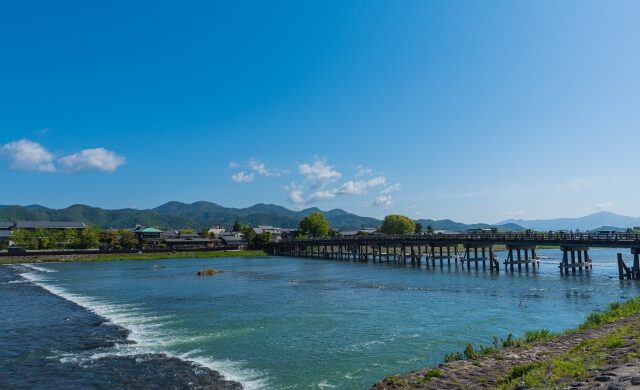
Togetsukyo Bridge
is one of Kyoto’s
most famous landmarks
and the symbol
of Arashiyama.
Stretching across
the Katsura River,
the bridge has welcomed visitors
for centuries
with its peaceful scenery
and beautiful mountain views.
No matter the season,
Togetsukyo Bridge
offers a timeless landscape
that captures
the charm of Kyoto.
🟫 MINI MEMO
The name “Togetsukyo”
means
“Moon-Crossing Bridge.”
It is said
that Emperor Kameyama
named the bridge
after seeing
the moon appear
to cross above it.
History|歴史
The first bridge
at this location
is believed
to have been built
during the early Heian Period.
Although it has been rebuilt
many times
because of floods,
Togetsukyo Bridge
has remained
the symbol of Arashiyama
for centuries.
Today’s bridge
preserves
its traditional appearance
while using
a modern structure
for strength and safety.
🟫 MINI MEMO
Togetsukyo Bridge
is approximately
155 meters long.
Its graceful design
has made it
one of Kyoto’s
most famous bridges.
Walking Across Togetsukyo Bridge|渡月橋を歩く
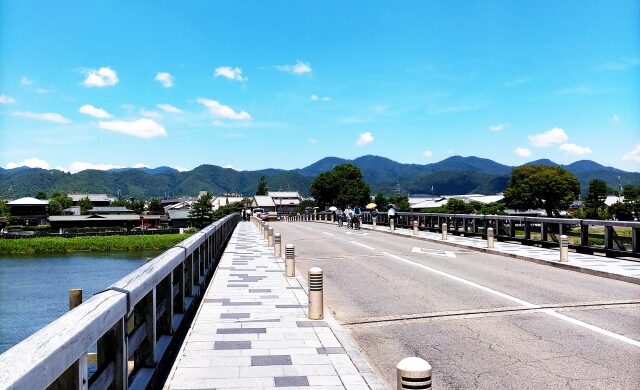
Walking across
Togetsukyo Bridge
is one of the highlights
of visiting Arashiyama.
From the bridge,
visitors can enjoy
wide views
of the Katsura River,
the surrounding mountains,
and the peaceful atmosphere
that makes this area
so special.
As you walk,
the scenery changes
with every step,
offering beautiful views
in every direction.
🟫 PHOTO TIP
Take your time
while crossing the bridge.
Some of the best views
are found
not on the bridge itself,
but from looking
upstream and downstream.
Bridge Entrance & Name Marker|橋のたもと・橋名柱
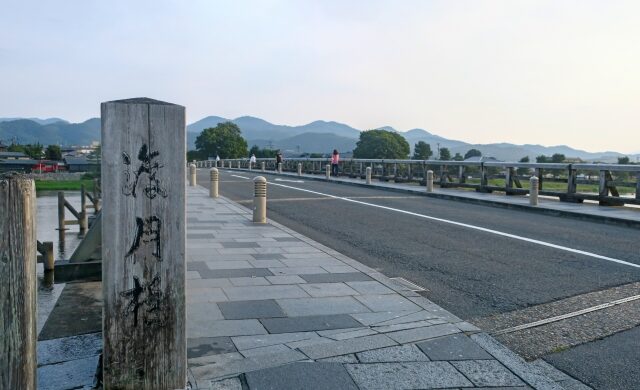
The entrance
to Togetsukyo Bridge
is one of the most popular
meeting places
in Arashiyama.
Many visitors
take commemorative photos
here before
walking across the bridge.
The wooden bridge marker
has also become
a familiar symbol
of Togetsukyo Bridge.
Bridge Structure|橋の構造
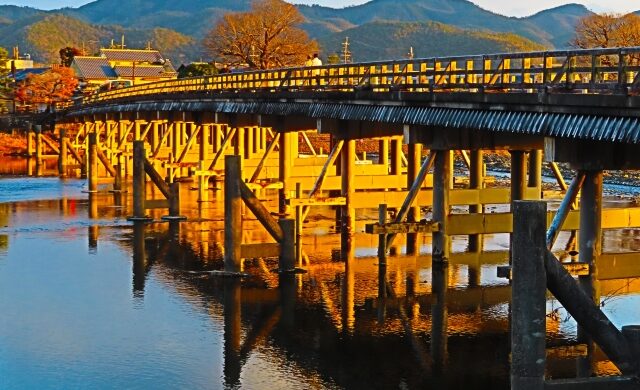
Seen from below,
Togetsukyo Bridge
reveals another side
of its beauty.
Although it appears
to be a traditional
wooden bridge,
the current bridge
uses reinforced concrete
beneath its traditional appearance.
This careful construction
helps preserve
the historic scenery
while ensuring
strength and durability.
🟫 MINI MEMO
The current bridge
was completed
in 1934.
Its appearance
was carefully designed
to blend naturally
with the surrounding scenery.
View Upstream|橋から見える上流の景色
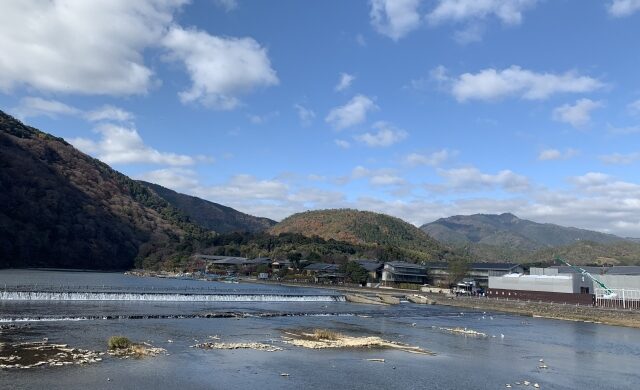
Looking upstream
from Togetsukyo Bridge,
visitors can enjoy
one of the most iconic
views in Arashiyama.
The gentle flow
of the Katsura River,
the low weir,
and the surrounding mountains
create a peaceful landscape
throughout the year.
Many people
pause here
to enjoy the scenery
before continuing
their walk across the bridge.
🟫 PHOTO TIP
Try looking upstream
after crossing
the middle of the bridge.
The wide view
is one of the best
photo spots
in Arashiyama.
View Downstream|橋から見える下流の景色
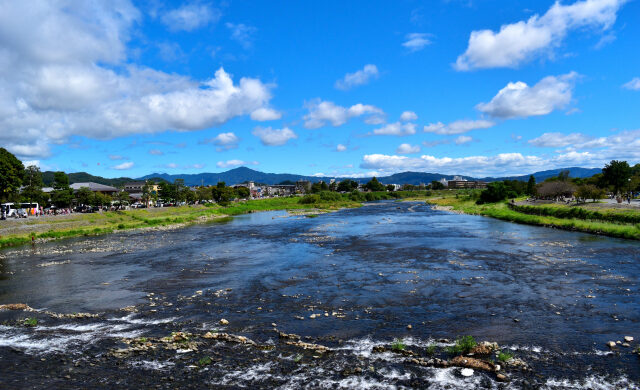
Looking downstream,
the Katsura River
flows gently
through Arashiyama.
The open sky,
the calm water,
and the distant mountains
create another peaceful view
from the bridge.
The peaceful atmosphere
invites visitors
to slow down
and enjoy
the scenery.
🟫 MINI MEMO
The Katsura River
is called
the Hozu River
farther upstream.
Its name changes
as it flows
through Kyoto.
Katsura River Boats|桂川の屋形舟
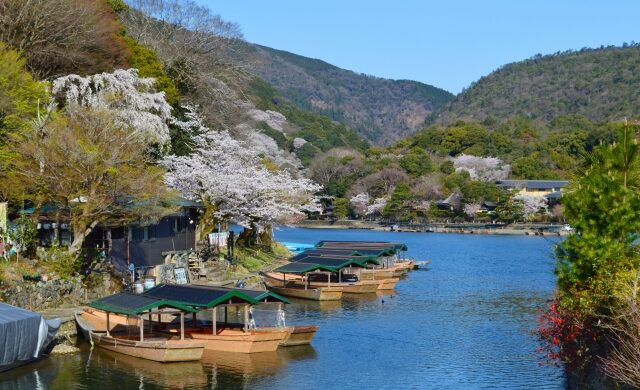
Traditional boats
floating on the Katsura River
have long been
part of Arashiyama’s scenery.
Their slow movement
matches
the peaceful atmosphere
of the river,
creating
a relaxing landscape.
Watching the boats
drift quietly downstream
is one of the simple pleasures
of visiting Togetsukyo Bridge.
🟫 MINI MEMO
River boats
have been enjoyed
in Arashiyama
for many years.
They continue
to be
one of the area’s
iconic sights.
Sunset at Togetsukyo Bridge|夕暮れの渡月橋
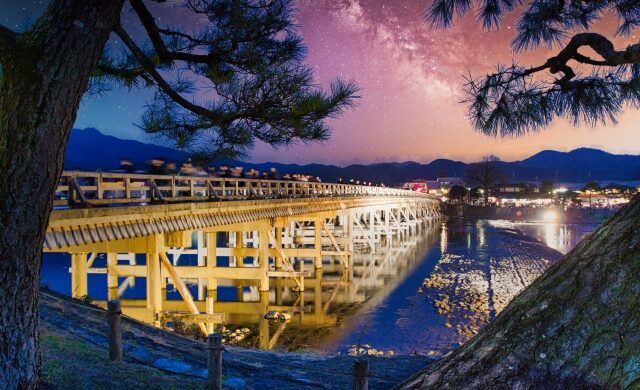
As the sun begins to set,
Togetsukyo Bridge
changes
into a peaceful
evening landscape.
The warm sunlight
reflects on the river,
while the surrounding mountains
are softly colored
by the evening sky.
It is one of
the most beautiful times
to experience
Arashiyama.
🟫 PHOTO TIP
Visit
during the golden hour
just before sunset.
The warm light
creates beautiful colors
across the bridge
and the river.
Best Time to Visit|おすすめの時間帯
Togetsukyo Bridge
can be enjoyed
at any time of day.
Early morning
offers a quiet atmosphere
with fewer visitors.
During the day,
the bridge becomes lively
with people exploring Arashiyama.
In the evening,
the warm light
creates a peaceful view
that feels completely different
from the daytime.
Whether you visit
for a short walk
or simply to enjoy the scenery,
every hour
has its own charm.
🟫 MINI MEMO
The bridge
is open all day,
so visitors can enjoy
its scenery
at any time.
🟫 CAT MEMO 🐾
“Was I… a little too fluffy?”🐾
🗺 Google Map
Togetsukyo Bridge
is much more than
a bridge across a river.
Its long history,
beautiful scenery,
and peaceful atmosphere
have made it
one of Kyoto’s
most beloved landmarks.
Walking across the bridge,
listening to the flowing river,
and looking toward
the surrounding mountains
are experiences
that remain
long after the journey ends.🌿
Thank you
for visiting
Togetsukyo Bridge.
We hope
your time
in Arashiyama
brings you
peace,
beautiful memories,
and a wonderful journey
through Kyoto. 🐾
🗺 Explore More Kyoto Areas
Kyoto is divided into several unique areas, each offering different attractions and experiences.